
Cryogenic bulk storage tanks are insulated pressure vessels designed to store liquefied gases such as liquid oxygen (LOX), liquid nitrogen (LIN), liquid argon (LAr), liquid carbon dioxide (LCO₂), and liquefied natural gas (LNG) at extremely low temperatures. Selecting the right cryogenic tank size and capacity requires consideration of gas consumption, storage volume, operating pressure, insulation performance, installation space, and delivery requirements.
This technical guide covers vertical and horizontal cryogenic bulk storage tanks with effective capacities from 5 m³ to 100 m³. It provides model-specific information about tank dimensions, working pressure, static evaporation rates, vessel weights, materials, and insulation configurations to help engineers and industrial gas buyers evaluate suitable storage equipment.
For product selection, see our cryogenic tanks and industrial gas supply systems.
Cryogenic Bulk Storage Tank Sizes and Capacities
Cryogenic storage tanks are available in different capacities to accommodate the storage and supply requirements of industrial gas facilities, manufacturing plants, hospitals, laboratories, and energy projects.
Tank capacity is generally specified in cubic metres (m³), litres (L), or US gallons (gal). The following table provides a general reference for common bulk storage capacities. These are approximate capacity classifications, not a specification of every manufactured model.
| Tank Size (US gal) | Approximate Volume (L) | Approximate Volume (m³) | Typical Application |
|---|---|---|---|
| 120 | 450 | 0.45 | Small facilities and laboratories |
| 250 | 950 | 0.95 | Medical oxygen backup and welding |
| 500 | 1,900 | 1.90 | Light industrial applications |
| 1,000 | 3,800 | 3.80 | Commercial and industrial gas supply |
| 2,000 | 7,600 | 7.60 | Industrial gas storage |
| 4,000 | 15,000 | 15.00 | Centralized gas supply facilities |
| 6,000 | 22,700 | 22.70 | Large industrial operations |
| 10,000+ | 37,850+ | 37.85+ | Large-scale industrial and energy facilities |
Actual tank dimensions, usable filling volume, pressure ratings, and construction specifications vary by gas type and engineering design. For detailed model specifications, refer to the manufacturer data below.
For liquid oxygen storage applications, explore our LN2 cryogenic tanks for available storage capacities and equipment configurations.
Vertical Cryogenic Bulk Storage Tank Sizes (5–100 m³)
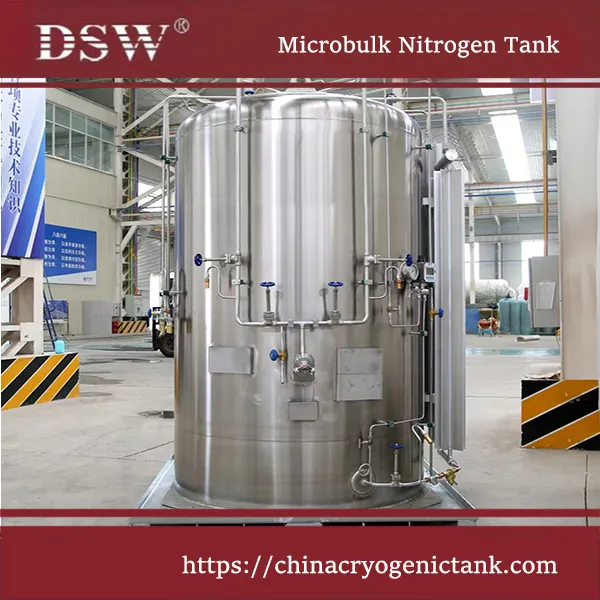
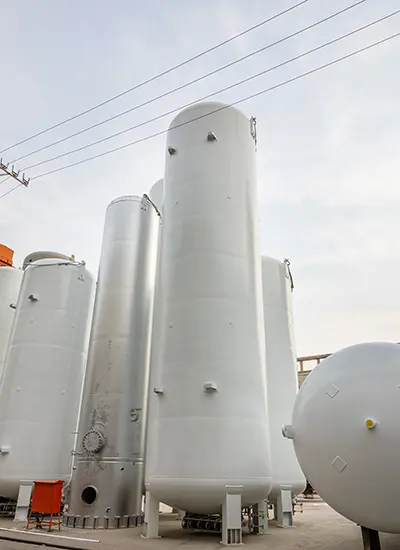
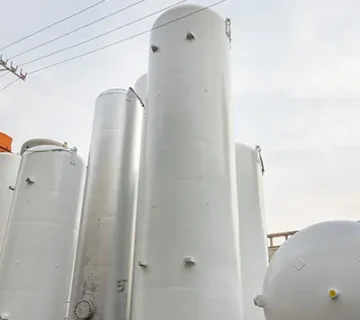
Vertical cryogenic tanks are designed for stationary installation where a relatively small ground footprint is preferred. They feature an inner storage vessel and an outer protective vessel, with vacuum powder insulation between the two layers.
The following specifications cover vertical LOX, LIN, and LAr storage tanks with effective volumes ranging from 5 m³ to 100 m³. Two working pressure configurations, 0.8 MPa and 1.6 MPa, are included in the supplied model range.
Vertical LOX, LIN and LAr Tank Specifications
| Model | Effective Volume (m³) | Working Pressure (MPa) | Static Evaporation (%/day) | Inner Tank Weight (kg) | Total Weight (kg) | Inner Tank Dimensions (mm) | Outer Tank Dimensions (mm) |
|---|---|---|---|---|---|---|---|
| V-5/0.8 | 5 | 0.8 | 0.43 | 1,040 | 1,430 | Φ1400 × 3680 × 6 | Φ1900 × 5115 × 8 |
| V-5/1.6 | 5 | 1.6 | 0.43 | 1,600 | 2,250 | Φ1400 × 3680 × 10 | Φ1900 × 5115 × 8 |
| V-10/0.8 | 10 | 0.8 | 0.36 | 1,980 | 2,565 | Φ1700 × 4950 × 8 | Φ2200 × 6400 × 8 |
| V-10/1.6 | 10 | 1.6 | 0.36 | 3,020 | 3,815 | Φ1700 × 4950 × 12 | Φ2200 × 6400 × 8 |
| V-15/0.8 | 15 | 0.8 | 0.35 | 2,735 | 3,272 | Φ1900 × 5950 × 8 | Φ2400 × 7330 × 8 |
| V-15/1.6 | 15 | 1.6 | 0.35 | 4,460 | 5,293 | Φ1900 × 5950 × 14 | Φ2400 × 7330 × 8 |
| V-20/0.8 | 20 | 0.8 | 0.33 | 3,575 | 3,925 | Φ2100 × 6465 × 8/10 | Φ2600 × 7955 × 8 |
| V-20/1.6 | 20 | 1.6 | 0.33 | 5,530 | 6,030 | Φ2100 × 6465 × 14 | Φ2600 × 7955 × 8 |
| V-30/0.8 | 30 | 0.8 | 0.29 | 5,300 | 5,630 | Φ2400 × 7410 × 10 | Φ3000 × 8930 × 10 |
| V-30/1.6 | 30 | 1.6 | 0.29 | 8,300 | 8,730 | Φ2400 × 7410 × 16 | Φ3000 × 8930 × 10 |
| V-50/0.8 | 50 | 0.8 | 0.23 | 8,705 | 9,080 | Φ2600 × 10380 × 10/12 | Φ3200 × 12000 × 12 |
| V-50/1.6 | 50 | 1.6 | 0.23 | 14,045 | 14,460 | Φ2600 × 10380 × 18/20 | Φ3200 × 12000 × 12 |
| V-100/0.8 | 100 | 0.8 | 0.16 | 16,140 | 16,457 | Φ3000 × 15425 × 12/14 | Φ3600 × 17260 × 14 |
| V-100/1.6 | 100 | 1.6 | 0.16 | 27,570 | 27,800 | Φ3000 × 15425 × 22 | Φ3600 × 17260 × 14 |
Specification notes: The dimensions are shown as diameter × length × wall thickness (mm), following the supplied manufacturer data. Inner and outer vessel dimensions are listed separately. Static evaporation figures are reference values from the supplied specifications and should be evaluated under the applicable test conditions.
For liquid argon storage projects, explore our LAr cryogenic tanks for available capacities and vertical or horizontal storage configurations.
Horizontal Cryogenic Bulk Storage Tank Sizes (5–100 m³)
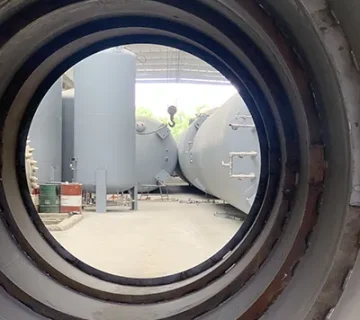
Horizontal cryogenic storage tanks provide an alternative configuration for industrial facilities where installation height, foundation arrangement, transportation access, or site layout influences equipment selection.
The supplied horizontal tank range covers 5 m³, 10 m³, 15 m³, 20 m³, 30 m³, 50 m³, and 100 m³ capacities. Models are available in 0.8 MPa and 1.6 MPa working pressure configurations.
Horizontal LOX, LIN and LAr Tank Specifications
| Model | Effective Volume (m³) | 3M | Working Pressure (MPa) | Static Evaporation (%/day) | LO Weight (kg) | LN Weight (kg) | LAr Weight (kg) | Total Weight (kg) | Inner Tank Dimensions (mm) | Outer Tank Dimensions (mm) |
|---|---|---|---|---|---|---|---|---|---|---|
| H-5/0.8 | 5 | 0.65 | 0.8 | 0.43 | 1,000 | 1,550 | 1,920 | 4,490 | Φ1400 × 3680 × 6 | Φ1900 × 4980 × 8 |
| H-5/1.6 | 5 | 0.65 | 1.6 | 0.43 | 1,550 | 1,920 | 3,040 | 5,100 | Φ1400 × 3680 × 10 | Φ1900 × 4980 × 8 |
| H-10/0.8 | 10 | 0.55 | 0.8 | 0.36 | 1,920 | 3,040 | 2,650 | 7,510 | Φ1700 × 4950 × 8 | Φ2200 × 6250 × 8 |
| H-10/1.6 | 10 | 0.55 | 1.6 | 0.36 | 3,040 | 2,650 | 4,380 | 8,550 | Φ1700 × 4950 × 12 | Φ2200 × 6250 × 8 |
| H-15/0.8 | 15 | 0.53 | 0.8 | 0.35 | 2,650 | 3,350 | 4,950 | 9,450 | Φ1900 × 5950 × 8 | Φ2400 × 7150 × 8 |
| H-15/1.6 | 15 | 0.53 | 1.6 | 0.35 | 4,380 | 4,950 | 5,210 | 11,250 | Φ1900 × 5950 × 14 | Φ2400 × 7150 × 8 |
| H-20/0.8 | 20 | 0.50 | 0.8 | 0.33 | 3,350 | 4,950 | 5,210 | 11,350 | Φ2100 × 6465 × 8/10 | Φ2600 × 7830 × 8 |
| H-20/1.6 | 20 | 0.50 | 1.6 | 0.33 | 4,950 | 5,210 | 8,180 | 13,400 | Φ2100 × 6465 × 14 | Φ2600 × 7830 × 8 |
| H-30/0.8 | 30 | 0.44 | 0.8 | 0.29 | 5,210 | 8,180 | 8,000 | 17,400 | Φ2400 × 7410 × 10 | Φ3000 × 8750 × 10 |
| H-30/1.6 | 30 | 0.44 | 1.6 | 0.29 | 8,180 | 8,000 | 13,535 | 20,400 | Φ2400 × 7410 × 16 | Φ3000 × 8750 × 10 |
| H-50/0.8 | 50 | 0.35 | 0.8 | 0.23 | 8,000 | 13,535 | 14,740 | 26,150 | Φ2600 × 10380 × 10 | Φ3200 × 11780 × 12 |
| H-50/1.6 | 50 | 0.35 | 1.6 | 0.23 | 13,535 | 14,740 | 27,070 | 31,750 | Φ2600 × 10380 × 18 | Φ3200 × 11750 × 12 |
| H-100/0.8 | 100 | 0.25 | 0.8 | 0.16 | 14,740 | 27,070 | 4,490 | 45,900 | Φ3000 × 15425 × 12/14 | Φ3500 × 16870 × 14 |
| H-100/1.6 | 100 | 0.25 | 1.6 | 0.16 | 27,070 | 4,490 | 58,225 | 58,225 | Φ3000 × 15425 × 22 | Φ3600 × 16870 × 14 |
Important: The gas-specific weight columns and total weights above reproduce the supplied data. Some figures require confirmation against the original engineering specification sheet before being used for procurement, transportation, or foundation calculations.
Vertical LCO₂ Cryogenic Storage Tank Sizes
Liquid carbon dioxide (LCO₂) requires storage equipment designed for its specific pressure and temperature conditions. Vertical LCO₂ cryogenic tanks use an insulated inner vessel and outer shell to maintain the required storage conditions.
The supplied vertical LCO₂ tank range includes effective capacities from 5 m³ to 100 m³, with a specified working pressure of 2.16 MPa and test pressure of 2.65 MPa.
Vertical LCO₂ Tank Technical Specifications
| Model | Effective Volume (m³) | Working Pressure (MPa) | Test Pressure (MPa) | Leak Test | Inner Tank Material | Outer Tank Material | Interlayer Insulation | Inner Tank Dimensions (mm) | Outer Tank Dimensions (mm) | Inner Tank Weight (kg) | Total Weight (kg) |
|---|---|---|---|---|---|---|---|---|---|---|---|
| V-5/2.16 | 5 | 2.16 | 2.65 | Helium test | 16MnDR | Q235-B | Expanded perlite | Φ1400 × 3680 × 12 | Φ1900 × 4980 × 8 | 1,000 | 4,490 |
| V-10/2.16 | 10 | 2.16 | 2.65 | Helium test | 16MnDR | Q235-B | Expanded perlite | Φ1700 × 4960 × 14 | Φ1900 × 4980 × 8 | 1,550 | 5,100 |
| V-15/2.16 | 15 | 2.16 | 2.65 | Helium test | 16MnDR | Q235-B | Expanded perlite | Φ1900 × 5920 × 14 | Φ2200 × 6250 × 8 | 1,920 | 7,510 |
| V-20/2.16 | 20 | 2.16 | 2.65 | Helium test | 16MnDR | Q235-B | Expanded perlite | Φ2000 × 7075 × 6 | Φ2200 × 6250 × 8 | 3,040 | 8,550 |
| V-30/2.16 | 30 | 2.16 | 2.65 | Helium test | 16MnDR | Q235-B | Expanded perlite | Φ2400 × 7460 × 18 | Φ2400 × 7150 × 8 | 2,650 | 9,450 |
| V-50/2.16 | 50 | 2.16 | 2.65 | Helium test | 16MnDR | Q235-B | Expanded perlite | Φ2600 × 10395 × 20 | Φ2400 × 7150 × 8 | 4,380 | 11,250 |
| V-100/2.16 | 100 | 2.16 | 2.65 | Helium test | 16MnDR | Q235-B | Expanded perlite | Φ3000 × 15425 × 24 | Φ2600 × 7830 × 8 | 3,350 | 11,350 |
The above values are reproduced from the supplied LCO₂ specifications. The vessel dimensions and weight figures should be checked against approved model drawings before being used as final engineering or installation data.
For more information, visit our LCO₂ cryogenic tank product range.
Vertical LNG Cryogenic Tank Sizes and Specifications
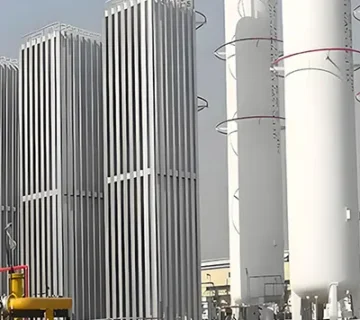
Liquefied natural gas (LNG) storage requires specially engineered cryogenic vessels designed for the properties of LNG and the operating conditions of the installation. Vertical LNG tanks in the supplied model range have effective capacities from 5 m³ to 100 m³.
The supplied specifications include 0.8 MPa working pressure, expanded perlite insulation, inner and outer vessel materials, helium leak testing, and static evaporation rates.
Vertical LNG Tank Technical Specifications
| Model | Effective Volume (m³) | Working Pressure (MPa) | Loading Medium | Inner Tank Material | Outer Tank Material | Insulation | Test Pressure (MPa) | Leak Test | Static Evaporation (%/day) | Inner Tank Weight (kg) | Total Weight (kg) | Inner Tank Dimensions (mm) | Outer Tank Dimensions (mm) |
|---|---|---|---|---|---|---|---|---|---|---|---|---|---|
| V-5/0.8 | 5 | 0.8 | LNG | 16MnDR | Q235-B | Expanded perlite | 1.1 | Helium test | 0.65 | 1,040 | 4,430 | Φ1400 × 3680 × 6 | Φ1900 × 5115 × 8 |
| V-10/0.8 | 10 | 0.8 | LNG | 16MnDR | Q235-B | Expanded perlite | 1.1 | Helium test | 0.55 | 1,980 | 7,230 | Φ1700 × 4950 × 8 | Φ2200 × 6400 × 8 |
| V-15/0.8 | 15 | 0.8 | LNG | 16MnDR | Q235-B | Expanded perlite | 1.1 | Helium test | 0.53 | 2,735 | 9,080 | Φ1900 × 5905 × 8 | Φ2400 × 7330 × 8 |
| V-20/0.8 | 20 | 0.8 | LNG | 16MnDR | Q235-B | Expanded perlite | 1.1 | Helium test | 0.50 | 3,575 | 11,010 | Φ2100 × 6465 × 8/10 | Φ2600 × 7955 × 8 |
| V-30/0.8 | 30 | 0.8 | LNG | 16MnDR | Q235-B | Expanded perlite | 1.1 | Helium test | 0.44 | 5,300 | 16,440 | Φ2400 × 7410 × 10 | Φ3000 × 8930 × 10 |
| V-50/0.8 | 50 | 0.8 | LNG | 16MnDR | Q235-B | Expanded perlite | 1.1 | Helium test | 0.35 | 8,705 | 25,870 | Φ2600 × 10380 × 10/12 | Φ3200 × 12000 × 12 |
| V-100/0.8 | 100 | 0.8 | LNG | 16MnDR | Q235-B | Expanded perlite | 1.1 | Helium test | 0.25 | 16,140 | 48,765 | Φ3000 × 15425 × 12/14 | Φ3600 × 17260 × 14 |
Technical verification: The supplied LNG data also contains a design-pressure entry recorded as “0.84-0.1” and an inner tank temperature of −196 °C. These fields have been omitted from the table pending confirmation by the engineering team. The LNG design pressure, design temperature, and applicable test conditions should be verified against the approved vessel documentation before publication.
Explore our LNG storage Tanks for additional equipment and application information.
Vertical vs. Horizontal Cryogenic Storage Tanks
Both vertical and horizontal cryogenic tanks are available for stationary bulk gas storage. The appropriate configuration depends on available installation space, tank capacity, foundation requirements, site access, and the overall gas supply system.
| Comparison | Vertical Cryogenic Tanks | Horizontal Cryogenic Tanks |
|---|---|---|
| Configuration | Upright vessel | Horizontally arranged vessel |
| Installation footprint | Generally smaller ground footprint | Generally requires more ground length |
| Installation height | Requires adequate vertical clearance | Generally lower overall profile |
| Site planning | Consider height, foundation and maintenance access | Consider length, support arrangement and access |
| Capacity range in supplied data | 5–100 m³ | 5–100 m³ |
| Applications | Stationary industrial gas storage | Stationary industrial gas storage |
The choice between vertical and horizontal configurations should be based on the approved equipment layout and site conditions rather than capacity alone.
What Determines the Right Cryogenic Tank Size?
Selecting a cryogenic bulk storage tank involves more than matching the nominal vessel capacity to the required gas volume. The following factors should be evaluated during equipment selection.
1. Daily Gas Consumption
Estimate average and peak gas consumption for the facility. The required storage capacity should support normal operating demand while providing an appropriate reserve for fluctuations in production or supply interruptions.
2. Delivery Frequency and Supply Logistics
Consider the delivery schedule, transport capacity, supplier distance, unloading arrangements, and the time required to replenish the tank. Facilities with less frequent deliveries may require greater storage capacity.
3. Working Pressure and Gas Supply Requirements
The tank’s working pressure must be compatible with the downstream gas supply system and operating requirements. Consider the pressure needed by vaporizers, pressure regulators, pipelines, and connected equipment.
4. Available Installation Space
Evaluate the installation footprint, overall vessel height, foundation, access for tankers, maintenance clearance, and applicable safety distances. Vertical and horizontal configurations may have different site-planning requirements.
5. Insulation and Static Evaporation Rate
Vacuum powder insulation helps reduce heat transfer from the surroundings into the cryogenic liquid. Static evaporation rate is an important specification when comparing tanks, particularly for facilities with extended storage periods or fluctuating demand.
For additional information, see our guide to preventing boil-off gas in cryogenic storage.
6. Applicable Standards and Regulatory Requirements
Tank design, materials, fabrication, inspection, pressure testing, and installation must comply with the applicable codes and regulations in the destination market. Requirements vary by gas, pressure classification, jurisdiction, and equipment application.
How to Calculate the Required Cryogenic Storage Capacity
A preliminary tank-sizing assessment should consider liquid consumption, delivery intervals, reserve requirements, and the usable filling capacity of the vessel.
A simplified planning relationship is:
Required usable storage volume = Daily liquid consumption × Required storage days
The nominal tank capacity must then account for permitted filling limits, reserve volume, operating conditions, and the manufacturer’s recommended filling parameters.
For example, a facility consuming 2 m³ of liquid nitrogen per day and requiring five days of usable storage would need 10 m³ of usable liquid storage before additional allowances are considered.
This is a preliminary planning calculation, not a final tank selection. Actual nominal capacity should be determined using the liquid’s properties, allowable filling ratio, operating pressure, delivery arrangements, and engineering requirements.
Cryogenic Bulk Storage Tank Applications
Different cryogenic liquids serve different industrial applications. Tank capacity and design must be matched to the properties of the stored medium and the facility’s gas consumption requirements.
Liquid Oxygen (LOX)
Liquid oxygen storage supports medical oxygen supply, metal fabrication, steelmaking, wastewater treatment, and other industrial oxygen applications. Tank selection must account for oxygen compatibility, cleanliness, pressure requirements, and the applicable oxygen-service safety provisions.
Liquid Nitrogen (LIN)
Liquid nitrogen tanks are used in industrial cooling, food processing, pharmaceutical manufacturing, laboratories, electronics production, and other applications requiring low-temperature storage or nitrogen supply.
Liquid Argon (LAr)
Liquid argon storage supports welding, metal production, industrial shielding, electronics manufacturing, and specialty gas supply systems. The tank configuration should match the required argon consumption and delivery schedule.
Liquid Carbon Dioxide (LCO₂)
LCO₂ storage is used in food and beverage processing, industrial cooling, chemical applications, and carbon dioxide distribution. Its storage pressure and operating conditions differ from those of atmospheric-pressure cryogenic liquids, so dedicated vessel specifications are important.
Liquefied Natural Gas (LNG)
LNG tanks are used in natural gas storage, industrial energy supply, distributed gas infrastructure, and LNG fueling applications. Tank sizing should account for gas demand, operating pressure, insulation performance, and the requirements of the complete LNG installation.
Technical Specifications to Check Before Ordering
When comparing cryogenic bulk storage tank models, buyers and engineering teams should request a complete technical specification sheet and approved drawings.
- Effective storage volume: Nominal and usable liquid storage capacity.
- Design pressure: Maximum pressure used for vessel design.
- Working pressure: Intended normal operating pressure.
- Test pressure: Pressure specified for the applicable vessel testing procedure.
- Design temperature: Temperature range for which the vessel is designed.
- Inner and outer vessel materials: Materials selected for the stored medium and operating conditions.
- Insulation system: Vacuum, expanded perlite or other specified insulation arrangement.
- Static evaporation rate: Manufacturer’s stated evaporation performance under defined conditions.
- Dimensions: Overall diameter, length or height, connections and installation envelope.
- Empty weight: Vessel weight for transportation and foundation planning.
- Accessories: Valves, pressure regulators, safety devices, level gauges and instrumentation.
- Certification and inspection: Applicable design codes, material certificates, inspection and test documentation.
These details are necessary for evaluating equipment compatibility, installation requirements, operating costs, and long-term reliability.
TECHNICAL FAQs
About Stationary Cryogenic Tank Sizes
Stationary cryogenic tanks are permanently installed, vacuum-insulated vessels designed to store liquefied gases at extremely low temperatures, typically below −150 °C. They provide continuous, long-term storage for industrial, medical, or LNG applications.
Cryogenic tank sizes are based on storage volume, usually in liters or gallons. Selection depends on daily gas consumption, delivery frequency, available installation space, pressure requirements, and regulatory compliance.
Cryogenic tanks can store a variety of liquefied gases including liquid oxygen (LOX), liquid nitrogen (LN₂), liquid argon (LAr), liquid carbon dioxide (LCO₂), and liquefied natural gas (LNG), depending on tank design and material compatibility.
Small tanks (120–500 gal) are used in labs and medical facilities, medium tanks (1,000–2,000 gal) in food processing and light industrial use, large tanks (4,000–6,000+ gal) for continuous industrial operations, and custom tanks (10,000+ gal) for LNG fueling or large-scale energy applications.
Key factors include gas consumption rate, delivery logistics, installation space, thermal management and boil-off losses, safety regulations, and long-term operational cost efficiency.
Cryogenic Storage Tank Projects
Find the Right Cryogenic Bulk Storage Tank for Your Project
Choosing a cryogenic storage tank involves more than selecting a capacity. Working pressure, vessel configuration, insulation performance, storage medium and site conditions all influence the required design.
BluNet can help assess vertical and horizontal tank configurations for liquid oxygen (LOX), liquid nitrogen (LIN), liquid argon (LAr), liquid CO₂ (LCO₂) and LNG applications.
To discuss your project, provide:
- Storage medium and required capacity
- Design or operating pressure
- Vertical or horizontal installation preference
- Site conditions and applicable standards
Discuss Your Cryogenic Tank Project →
Request model specifications, technical drawings and a quotation.

No comment