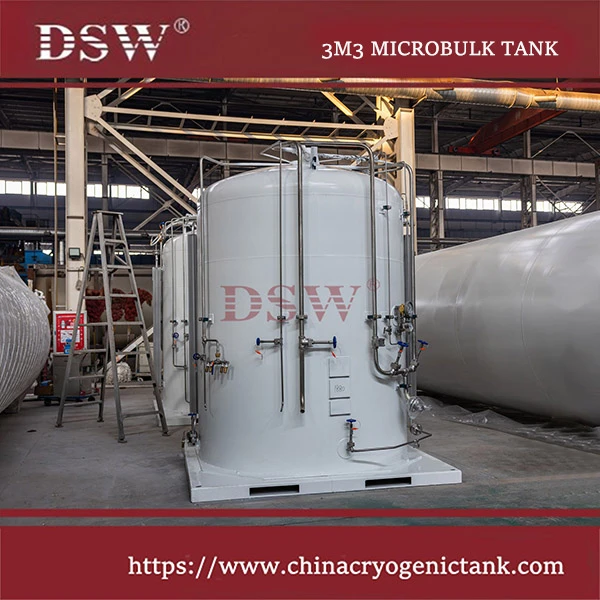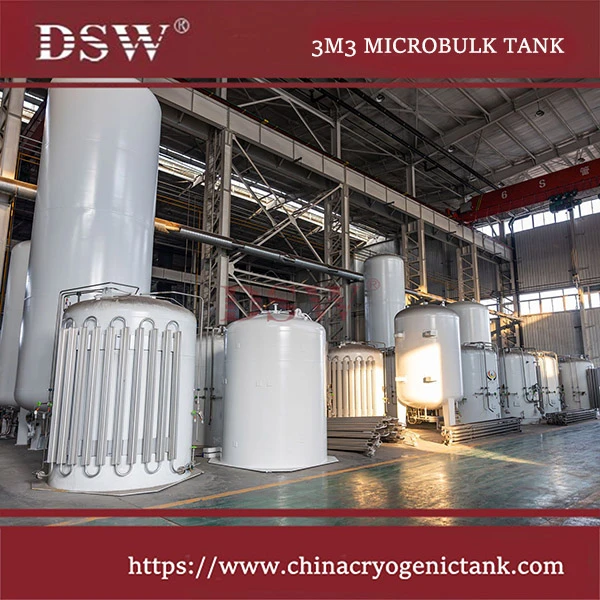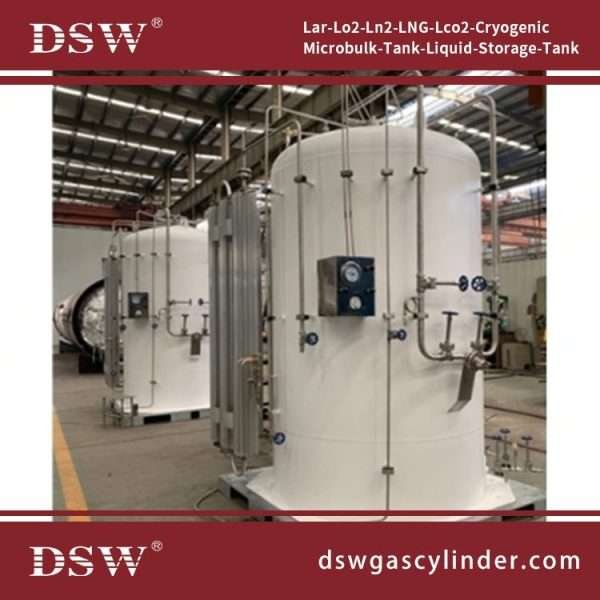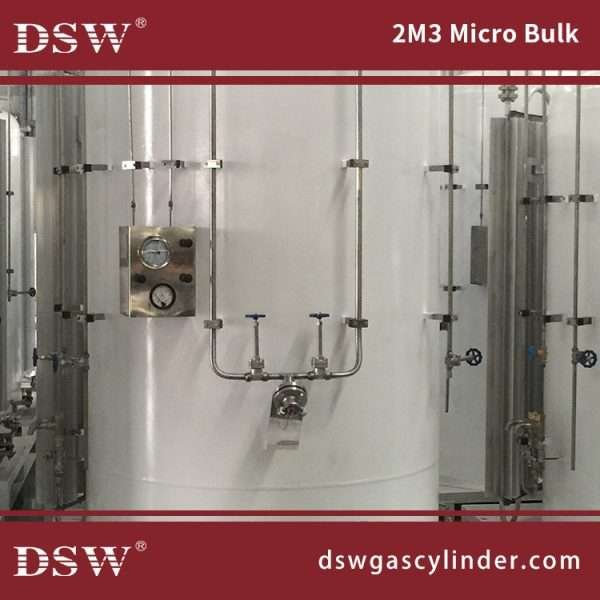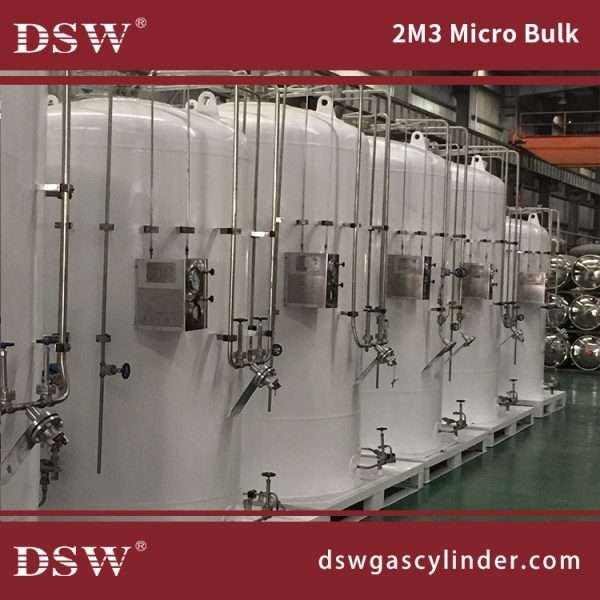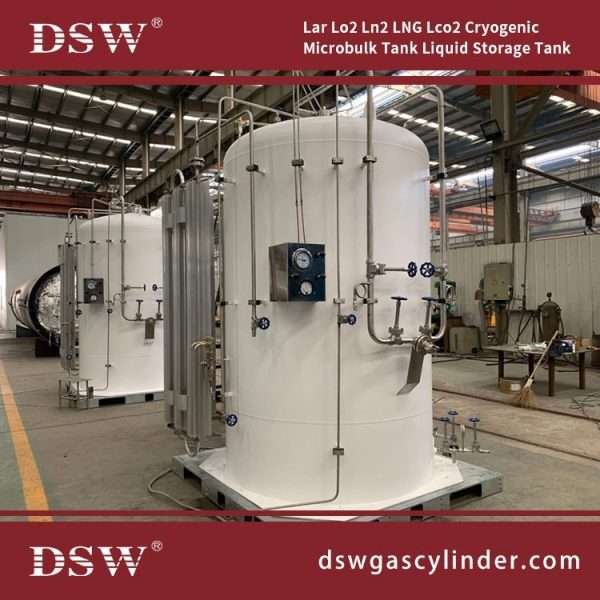


DSW Industry manufactures microbulk nitrogen tanks for on-site liquid nitrogen storage and supply. Available in major capacities from 1 m³ to 5 m³, these compact cryogenic storage systems are designed for industrial facilities, laboratories, healthcare environments, and other applications requiring a reliable liquid nitrogen supply.
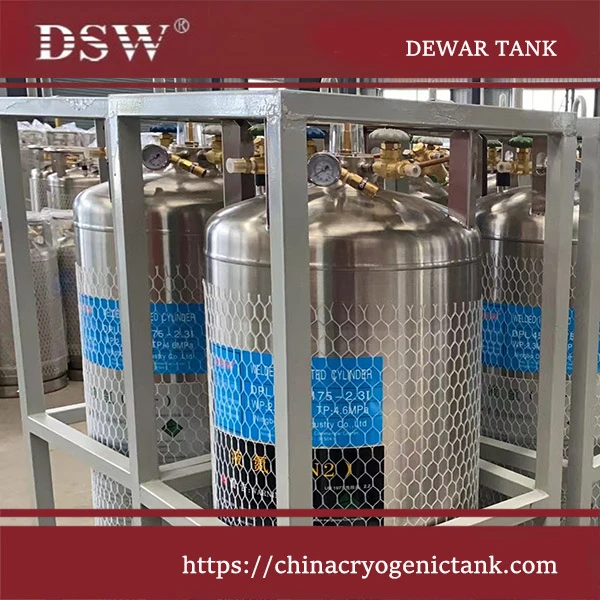
Compared with small liquid nitrogen dewars, microbulk nitrogen tanks provide greater storage capacity and can reduce manual handling and refill frequency. Compared with larger bulk storage installations, they offer a compact option for facilities with moderate nitrogen demand. The appropriate system depends on consumption, operating pressure, withdrawal requirements, site conditions, and delivery arrangements.
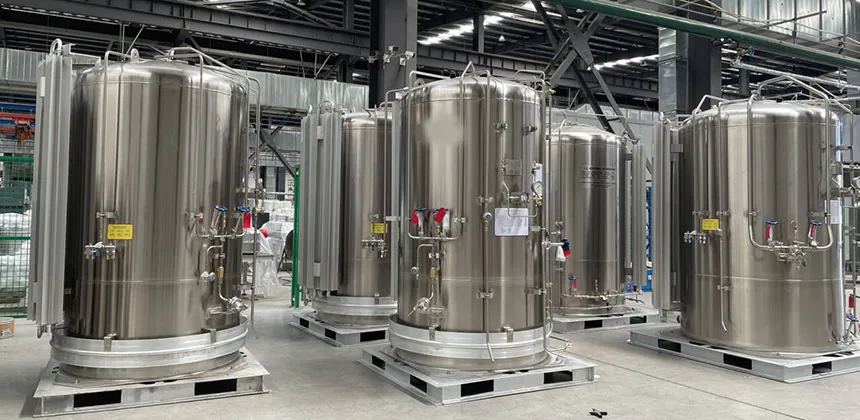
1 m³ Microbulk Nitrogen Tank Specifications
The following table lists the supplied technical data for model CDLS-1/1.6. These specifications are for the 1 m³ model only and should not be assumed to apply to every tank in the 1 m³–5 m³ capacity range.
| Model: CDLS-1/1.6 | Insulation Type: Multi-layer | |||
|---|---|---|---|
| No. | Specification | Inner Vessel | Outer Vessel |
| 1 | Design Pressure (MPa) | 1.68 | -0.1 (outer) |
| 2 | Working Pressure (MPa) | 1.6 | -0.1 (outer) |
| 3 | MAWP (MPa) | 1.68 | / |
| 4 | Design Temperature (°C) | -196 | -19 to 50 |
| 5 | Working Temperature (°C) | ≥ -196 | Normal |
| 6 | Strength Pressure (MPa) | 2.7 | HLD |
| 7 | Geometric Volume (m³) | 1.06 | 0.88 (interlayer) |
| 8 | Effective Volume (m³) | 1.0 | / |
| 9 | Medium | LIN (liquid nitrogen) | Multi-layer insulation |
| 10 | Main Material | S30408 | S30408 |
| 11 | Surface Treatment | Pickling and passivation | Sanding (Sa2.5) and coating |
| 12 | Corrosion Allowance (mm) | 0 | 0 |
| 13 | Joint Efficiency | 1.0 | 0.85 |
| 14 | Filling Rate | 95% | / |
| 15 | Static Evaporation (%/day) | LN₂ ≤ 1.0 | |
| 16 | Seal-off Vacuum Degree (Pa) | ≤ 0.01 | |
| 17 | Interlayer Seal Leakage | ≤ 1 × 10⁻⁸ | |
| 18 | Diameter (mm) | Φ900 | Φ1104 |
| 19 | External Dimensions (mm) | Φ1104 × 2444 | |
| 20 | Tank Orientation | Vertical | |
| 21 | Tare Weight (kg) | Approximately 986 | |
| 22 | Fully Loaded Weight with LIN (kg) | Approximately 1754 | |
| 23 | Design Service Life | 15 years | |
| 24 | Safety Valve Set Pressure (MPa) | 1.68 | |
| 25 | Maximum Medium Density (kg/m³) | 808 (LIN) | |
| 26 | Coating Thickness (µm) | / | |
| 27 | Ex-works Pressure of Inner Vessel | 0.03 MPa | |
| 28 | Design Code | GB | |
Technical Note: Confirm the design code, material grades, pressure-relief settings, strength-pressure terminology, interlayer leakage units, vacuum specification, and the meaning of “HLD” against the approved engineering datasheet. Verify the filling limit and test conditions for the stated evaporation rate. Final specifications must comply with the approved design and applicable regulations.
Key Features
Compact Cryogenic Storage
The 1 m³ to 5 m³ microbulk nitrogen tank range is intended for facilities that need more storage capacity than small portable dewars can provide without installing a larger bulk storage system. The final capacity should be selected according to nitrogen consumption, delivery frequency, and available installation space.
Insulation for Liquid Nitrogen Storage
Cryogenic insulation helps limit heat transfer into the liquid nitrogen and control evaporation during storage. The 1 m³ CDLS-1/1.6 specification identifies multilayer insulation. The precise insulation construction and performance should be confirmed for each model.
Controlled Nitrogen Supply
A suitably configured microbulk system can support liquid nitrogen withdrawal or gaseous nitrogen supply through compatible downstream equipment. Actual delivery pressure, flow rate, and vaporization capacity depend on the tank configuration and associated valves, regulators, and vaporizer.
Space-Efficient Installation
Vertical construction can help reduce the installation footprint. Buyers should assess the overall equipment dimensions, loaded weight, foundation, access for filling, maintenance clearance, and applicable site safety requirements.
Pressure Protection and Cryogenic Materials
The supplied 1 m³ model data identify an inner-vessel design pressure of 1.68 MPa, a working pressure of 1.6 MPa, and a listed safety valve set pressure of 1.68 MPa. These values must be checked against the approved pressure-relief design and applicable requirements before the equipment is specified or operated.
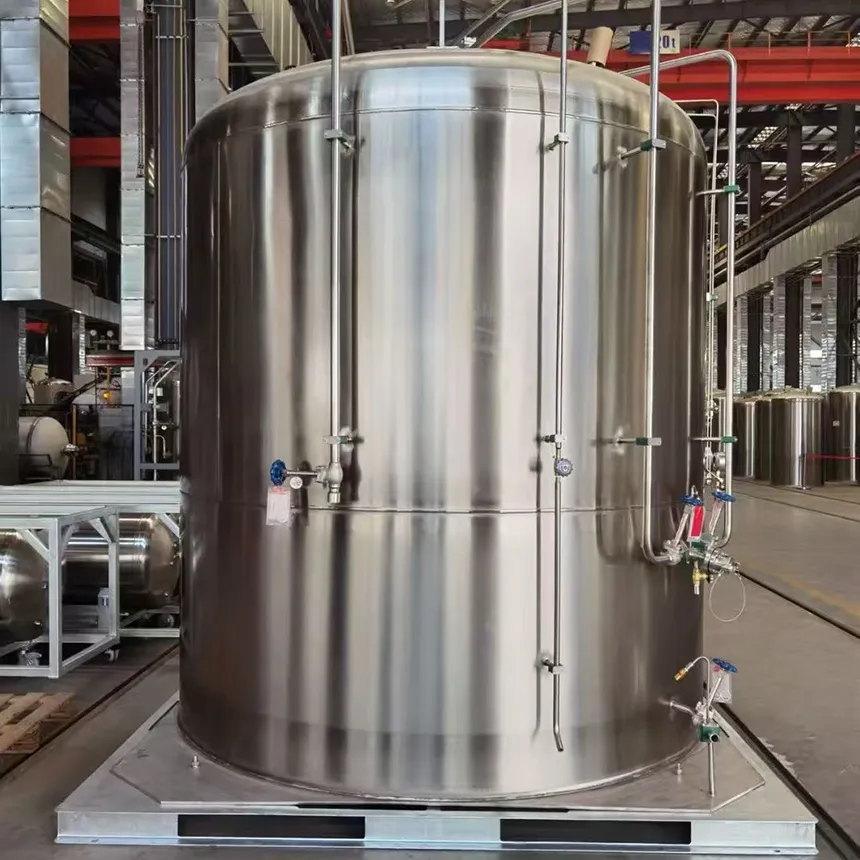
Applications of Microbulk Liquid Nitrogen
Microbulk liquid nitrogen storage can support a range of industrial and scientific processes, provided the system is correctly specified for the application.
- Industrial manufacturing and metal processing: Nitrogen supply for suitable inerting, purging, cooling, and process applications.
- Laboratories and research facilities: Liquid nitrogen supply for compatible laboratory equipment, scientific experiments, and sample-handling processes.
- Healthcare and life sciences: Cryogenic supply for appropriate laboratory and life-science applications, subject to the required equipment and operating procedures.
- Electronics and semiconductor manufacturing: Nitrogen supply for processes requiring controlled atmospheres and suitable gas purity.
- Food processing: Liquid nitrogen supply for compatible chilling, freezing, and food-processing operations.
The required nitrogen purity, flow rate, storage capacity, and delivery arrangement should be established before selecting a tank. Applications involving gaseous nitrogen may require a compatible vaporizer and pressure-control equipment.
How to Select a 1 m³–5 m³ Microbulk Nitrogen Tank
Selecting a suitable microbulk nitrogen tank requires more than matching the nominal capacity to daily consumption. Buyers should evaluate the complete storage and supply system.
- Storage capacity: Consider daily and peak nitrogen demand, delivery lead times, reserve requirements, and the desired refill frequency. DSW Industry’s major model range for this application is 1 m³–5 m³.
- Operating pressure: Specify the required tank operating pressure and downstream delivery pressure separately. The tank design and pressure-control components must be compatible with the intended duty.
- Liquid or gaseous withdrawal: Confirm whether the process requires liquid nitrogen, gaseous nitrogen, or both. Gas supply normally requires a suitably designed vaporization and pressure-control arrangement.
- Evaporation performance: Compare static evaporation data only when the measurement basis, test conditions, and applicable operating requirements are clear.
- Installation conditions: Check the available footprint, foundation, total loaded weight, filling access, ventilation, and the separation and safety requirements applicable to the site.
- Design and compliance: Confirm the applicable pressure-vessel code, inspection requirements, pressure-relief equipment, materials, and local regulatory approvals for the destination market.
For model selection, provide DSW Industry with your required capacity, working pressure, nitrogen consumption, withdrawal method, installation location, and destination country. These details help establish the appropriate technical configuration.
Request a Quote for a Microbulk Nitrogen Tank
DSW Industry offers 1 m³–5 m³ microbulk nitrogen tanks for liquid nitrogen storage and supply. For a technical quotation, please provide:
- Tank capacity and working pressure
- Daily nitrogen consumption and peak flow rate
- Liquid or gaseous nitrogen supply requirements
- Installation conditions and destination country
- Required design code, inspection, and certifications
Contact DSW Industry for a technical proposal and quotation.