
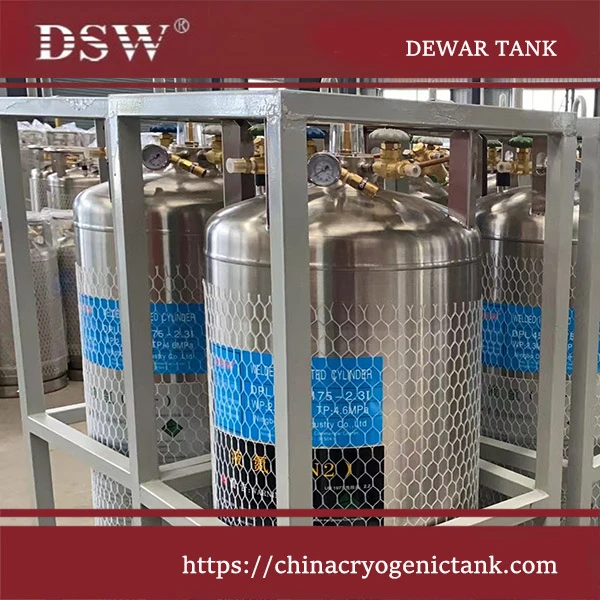
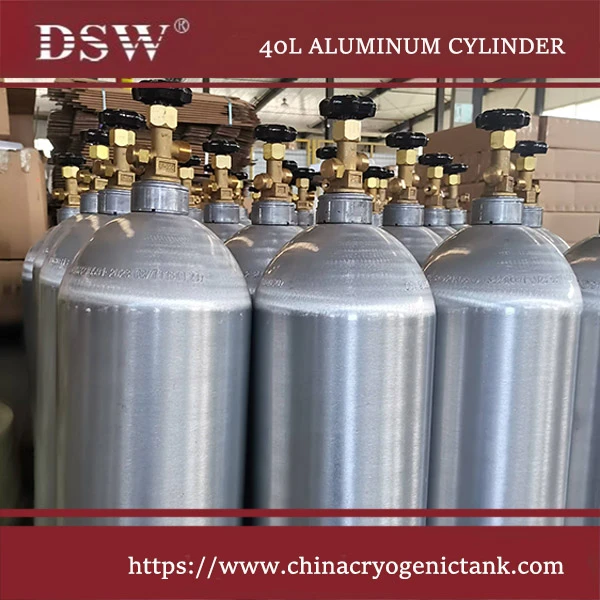
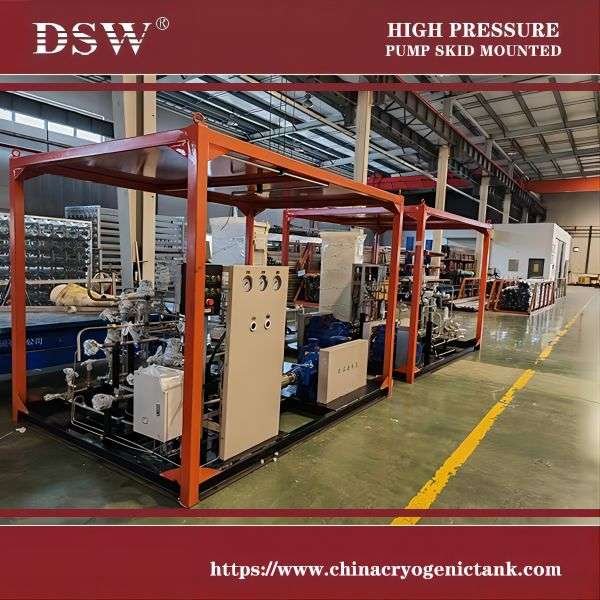
Industrial gas supply systems integrate gas storage, vaporization, pressure control, distribution piping, instrumentation, and safety equipment to deliver a stable supply of industrial gas from the source to the point of use.
For medium- and high-consumption facilities, a gas supply system is more than a storage tank or a group of cylinders. The storage method, pressure-control equipment, vaporizer capacity, distribution network, and backup supply must work together to meet the required gas flow, pressure, purity, storage capacity, and supply continuity.
DSW Industry designs and manufactures equipment for industrial gas storage, cryogenic liquid storage, gas vaporization, transportation, and distribution. Our solutions can be configured for gases including liquid nitrogen (LIN/LN₂), liquid oxygen (LOX), liquid argon (LAr), liquid carbon dioxide (LCO₂), LNG, and other compatible gases.
For an overview of cryogenic storage technology, see our Cryogenic Tanks Guide.
What Is an Industrial Gas Supply System?
An industrial gas supply system is an integrated installation that receives, stores, conditions, controls, and distributes gas to one or more points of use.
The system configuration depends on the gas phase, consumption profile, required purity, operating pressure, site conditions, and required supply continuity.
A typical system may include:
- Gas cylinders or cylinder bundles
- Bulk or cryogenic storage tanks
- Microbulk tanks and liquid gas storage vessels
- Pressure-building systems
- Cryogenic vaporizers
- Gas manifolds and valve assemblies
- Pressure regulators and control stations
- Gas distribution piping
- Filters and purification equipment
- Pressure, temperature, flow, and level instrumentation
- Pressure-relief and safety devices
- Monitoring, alarm, and emergency shutoff systems
The objective is to deliver gas to the process at the required pressure, flow rate, purity, temperature, and availability.
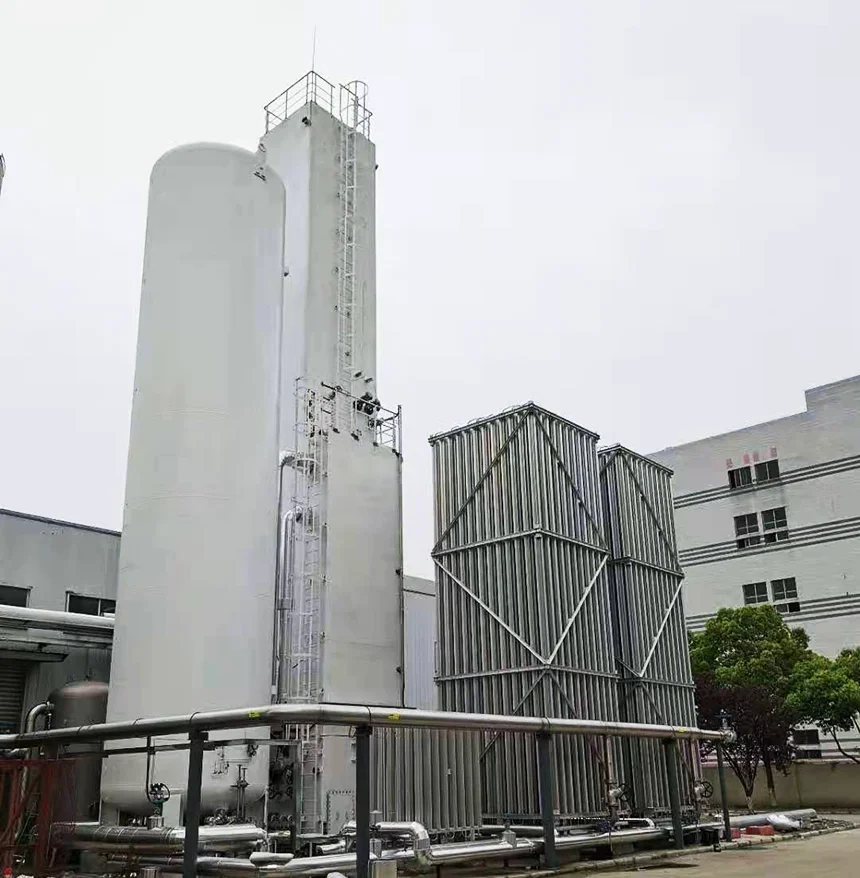
How Does an Industrial Gas Supply System Work?
Although individual installations vary, most industrial gas supply systems follow the same basic sequence: supply, storage, pressure control, vaporization, distribution, monitoring, and point of use.
- Gas supply: Gas enters the facility from cylinders, bulk deliveries, cryogenic tankers, ISO tanks, tube trailers, or an on-site gas generation system.
- Storage: The gas is stored in cylinders, microbulk tanks, stationary cryogenic tanks, or other storage equipment selected for the gas properties and required capacity.
- Pressure control: Regulators, pressure-building circuits, or pressure-control stations establish the pressure required by the downstream system.
- Vaporization: When liquid cryogenic gas is supplied, a vaporizer converts the liquid into gas at the required flow rate.
- Distribution: Gas passes through headers, valves, regulators, filters, and piping to the required production areas.
- Monitoring: Pressure, flow, temperature, tank level, and other operating parameters can be monitored to maintain stable operation.
- Point of use: The gas is delivered to production equipment, process machinery, laboratories, medical systems, or other end-use equipment at the specified conditions.
Industrial Gas Supply System Configurations
Industrial gas supply systems can be configured around different supply sources and storage methods. The most suitable arrangement depends primarily on gas consumption, delivery frequency, required reserve capacity, operating pressure, and site conditions.
1. Cylinder Gas Supply Systems
Cylinder-based systems use individual cylinders, cylinder bundles, manifolds, regulators, and changeover equipment to provide compressed gas.
They are commonly used for low- to moderate-consumption applications, intermittent gas demand, laboratory processes, welding, fabrication, and applications where flexible supply is important.
See our Gas Cylinders Guide for information about compressed gas storage.
2. Bulk Gas Supply Systems
Bulk gas systems use larger storage vessels to provide industrial facilities with a centralized supply of gas. They can reduce the frequency of cylinder replacement and are suitable for facilities with continuous or relatively high gas consumption.
Depending on the gas, bulk systems may use cryogenic liquid storage tanks or other purpose-designed pressure vessels.
3. Cryogenic Gas Supply Systems
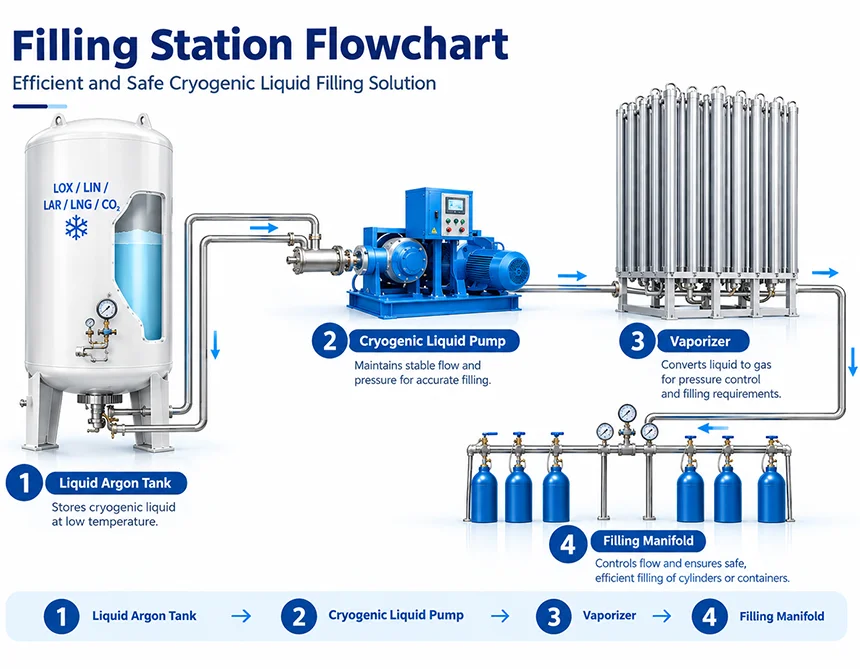
A cryogenic gas supply system stores an industrial gas in liquid form at very low temperature and converts it into gas when required.
A typical configuration includes:
- Vacuum-insulated cryogenic storage tank
- Pressure-building system
- Liquid and gas valves
- Cryogenic vaporizer
- Pressure-control equipment
- Gas distribution piping
- Safety and monitoring equipment
This configuration is widely used for higher-volume nitrogen, oxygen, argon, carbon dioxide, and other cryogenic gas applications.
Explore our cryogenic tanks and cryogenic storage solutions.
4. Microbulk Gas Supply Systems
Microbulk systems provide an intermediate supply option between high-pressure cylinders and large stationary bulk tanks.
A typical microbulk installation includes a small vacuum-insulated storage tank, pressure-control equipment, vaporization equipment, valves, instrumentation, and a connection to the customer’s gas distribution network.
Microbulk systems can be suitable for facilities with regular gas consumption that require fewer deliveries and more continuous supply without installing a large bulk tank.
DSW Industry supplies microbulk tanks for on-site storage and gas supply applications.
5. On-Site Gas Supply Systems
On-site supply systems generate or condition gas close to the point of consumption. Depending on the application, the system may combine gas generation, storage, purification, compression, pressure regulation, and distribution equipment.
This configuration can be considered when gas consumption is continuous and predictable or when delivered cylinders or liquid gas are not the preferred supply method.
Key Components of an Industrial Gas Supply System
An industrial gas supply system is an integrated arrangement of storage, vaporization, pressure control, distribution, safety, and monitoring equipment. Each component should be selected according to the gas service, operating pressure, temperature, flow rate, materials, installation conditions, and applicable regulations.
| Component | Primary Function | Key Selection Considerations |
|---|---|---|
| Gas Storage Tanks | Store industrial gases and provide the operating reserve required by the facility. | Gas type, storage capacity, operating pressure, design temperature, insulation method, site conditions, and applicable standards. |
| Cryogenic Vaporizers | Convert cryogenic liquid into gaseous form before or during delivery to the distribution system. | Continuous flow rate, peak demand, inlet liquid temperature, outlet pressure, ambient conditions, operating hours, and redundancy requirements. |
| Pressure-Building Equipment | Maintains the pressure required for liquid withdrawal and stable operation of a cryogenic storage tank. | Tank operating pressure, liquid withdrawal rate, ambient conditions, pressure requirements, and equipment configuration. |
| Pressure-Control Equipment | Regulates or reduces gas pressure before delivery to downstream equipment and points of use. | Inlet and outlet pressure, flow rate, pressure drop, gas compatibility, control accuracy, and relief protection. |
| Gas Manifolds | Connect multiple cylinders or supply sources to a common gas outlet. | Number of cylinders, gas type, operating pressure, required flow rate, manual or automatic changeover, and continuous-supply requirements. |
| Gas Distribution Piping | Transfers gas from storage, vaporization, or manifold equipment to individual points of use. | Flow rate, pressure drop, pipe length, fittings, gas properties, operating pressure, material compatibility, and future expansion. |
| Valves and Pressure-Relief Devices | Provide isolation, flow control, pressure protection, and emergency shutdown functions. | Gas service, pressure rating, temperature range, equipment design, installation arrangement, and applicable regulations. |
| Instrumentation and Monitoring | Provides operating data, alarms, and system status information for safe operation and maintenance. | Tank level, pressure, temperature, flow, alarm requirements, gas detection, remote monitoring, and automation requirements. |
Industrial Gas Supply System Design Considerations
System design should begin with the actual process requirements rather than selecting a tank or vaporizer first.
1. Gas Type and Physical Properties
Identify the gas, physical phase, temperature, pressure, compatibility requirements, flammability, toxicity, oxidizing properties, and other relevant characteristics.
Nitrogen, oxygen, argon, carbon dioxide, and LNG have different storage and handling requirements, so the supply system must be designed for the specific gas.
2. Average and Peak Gas Consumption
Determine both average and peak consumption. A system sized only for average demand may not provide sufficient gas during production peaks.
Consumption should preferably be expressed using consistent units such as Nm³/h, Sm³/h, kg/h, or another project-defined standard.
3. Required Operating Pressure
Define the pressure required at each point of use and the acceptable pressure range.
The supply system must account for pressure losses through vaporizers, regulators, valves, filters, piping, and other components.
4. Storage Capacity and Reserve
Storage capacity should be determined from gas consumption, delivery frequency, refill logistics, required reserve, and future demand.
Critical facilities may require additional reserve capacity or a secondary supply source to reduce the consequences of supply interruption.
5. Vaporizer Capacity
For liquid gas systems, the vaporizer must be sized for the required gas flow under the actual operating conditions.
Both continuous and peak demand should be considered when determining vaporizer capacity.
6. Distribution Network
The distribution network should be designed for the required flow and allowable pressure drop. Pipe diameter, routing, branch connections, isolation points, material compatibility, and future expansion should all be considered.
7. Supply Redundancy
Applications where gas interruption could affect production or safety may require dual storage, backup cylinders, reserve tanks, automatic changeover, or another redundant supply arrangement.
8. Site and Installation Conditions
The installation layout should account for tank foundation requirements, delivery vehicle access, equipment clearances, piping routes, ventilation, maintenance access, emergency access, and applicable safety distances.
Industrial Gas Supply System Configuration Comparison
| Supply Configuration | Typical Equipment | Typical Application |
|---|---|---|
| Cylinder Supply | Gas cylinders, manifolds, regulators, changeover equipment | Low to moderate and intermittent gas demand |
| Microbulk Supply | Microbulk tank, vaporizer, pressure control, distribution | Regular medium-volume gas consumption |
| Bulk Cryogenic Supply | Cryogenic storage tank, vaporizer, pressure control, piping | Continuous medium- to high-volume gas consumption |
| ISO Tank Supply | Cryogenic ISO tank, transfer equipment, storage or distribution system | Transportable or geographically flexible bulk supply |
| On-Site Gas Supply | Gas generation, purification, compression, storage and controls | Continuous demand with suitable on-site utilities |
Industrial Gases Used in Supply Systems
Nitrogen Gas Supply
Nitrogen is widely used for inerting, purging, blanketing, heat treatment, food processing, electronics manufacturing, and chemical processing.
Depending on consumption, nitrogen may be supplied using compressed gas cylinders, microbulk systems, or liquid nitrogen stored in bulk cryogenic tanks and vaporized on demand.
Oxygen Gas Supply
Oxygen is used in metal processing, combustion enhancement, cutting, chemical processing, wastewater treatment, healthcare, and other applications.
Higher-volume users may use bulk liquid oxygen storage with vaporization and pressure-control equipment.
Argon Gas Supply
Argon is commonly used as a shielding gas in welding and metal fabrication and for controlled-atmosphere applications.
Argon supply can be configured around cylinders, liquid cylinders, microbulk tanks, or bulk cryogenic storage depending on consumption.
Carbon Dioxide Supply
Carbon dioxide is used in food and beverage processing, welding, water treatment, chemical processing, and other industrial applications.
Higher-volume CO₂ users may use bulk liquid CO₂ storage with pressure control and vaporization equipment.
LNG Supply Systems
LNG systems require specialized storage and handling equipment because LNG is a cryogenic and flammable liquid. System design may include vacuum-insulated storage, pressure control, vaporizers, gas detection, emergency shutdown, and other application-specific safety systems.
Industrial Gas Distribution Systems
An industrial gas distribution system connects the primary gas supply with one or more points of use.
A distribution network can include:
- Main gas headers
- Branch pipelines
- Isolation valves
- Pressure regulators
- Filters
- Flow meters
- Point-of-use regulators
- Emergency shutoff devices
- Gas monitoring equipment
Distribution-system design should consider gas flow, pressure drop, pipe length, number of users, gas purity, material compatibility, maintenance access, isolation requirements, and future expansion.
The distribution network should therefore be treated as part of the overall gas supply system rather than as a separate piping project.
Industrial Gas Supply Applications
Industrial gas supply systems are used wherever production or process operations require a controlled and reliable supply of compressed or liquefied gases.
| Industry | Typical Gas Supply Applications |
|---|---|
| Chemical Processing | Inerting, blanketing, purging and process gases |
| Steel and Metal Processing | Oxygen enrichment, cutting, welding and inert atmospheres |
| Welding and Fabrication | Argon, CO₂, oxygen and shielding gas supply |
| Food and Beverage | Modified-atmosphere packaging, carbonation, freezing and inerting |
| Electronics and Semiconductor Manufacturing | High-purity and specialty gas supply |
| Healthcare | Medical oxygen and other medical gas infrastructure |
| Energy and LNG | LNG storage, vaporization and gas distribution |
| Water and Wastewater Treatment | Oxygenation and process gas applications |
Looking for a Industrial Gas Supply Solution?
Tell us your gas type, consumption, pressure, and storage requirements to discuss the right solution for your project.
Industrial Gas Supply System Safety
Industrial gas systems should be designed, installed, operated, and maintained according to the properties of the gas, equipment design, applicable pressure-vessel and piping requirements, and local regulations.
Important design considerations can include:
- Gas and material compatibility
- Pressure and temperature ratings
- Pressure-relief protection
- Ventilation
- Gas detection where applicable
- Emergency isolation and shutoff
- Safe cylinder and tank handling
- Leak inspection and maintenance
- Equipment identification and labeling
- Operator training
Cryogenic systems require additional consideration because cryogenic liquids can cause severe cold exposure and material embrittlement. Oxygen systems also require controls appropriate to oxygen-enriched environments because oxygen supports combustion.
LNG and other flammable gases require additional hazard controls, which may include gas detection, emergency shutdown systems, hazardous-area considerations, and controlled ignition sources according to the applicable design requirements.
How to Select an Industrial Gas Supply System
The correct configuration depends on the relationship between gas consumption, storage capacity, supply logistics, pressure requirements, site conditions, and required continuity.
| Selection Factor | Key Questions |
|---|---|
| Gas Type | What gas is being stored or supplied? What are its phase, temperature and compatibility requirements? |
| Consumption | What are the average, peak and future gas requirements? |
| Pressure | What pressure is required at the point of use? |
| Purity | What gas purity is required and is additional filtration or purification necessary? |
| Storage Capacity | How much operating reserve is required between deliveries? |
| Supply Continuity | Is backup storage or automatic changeover required? |
| Site Conditions | What space, foundation, access, ventilation and installation requirements apply? |
| Future Expansion | Will production capacity or gas consumption increase? |
Industrial Gas Supply Systems vs. Cylinder Supply
Cylinder supply remains practical for low-volume, intermittent, or variable gas consumption. However, as consumption increases, frequent cylinder replacement can create additional handling, logistics, storage, and production-management requirements.
Bulk, microbulk, and cryogenic supply systems can provide a more centralized approach for facilities with regular or higher gas demand.
The selection should be based on the complete supply requirement rather than gas volume alone. Delivery frequency, storage capacity, peak consumption, operating pressure, site conditions, labor requirements, and supply continuity should all be evaluated.
Integrated Cryogenic Gas Supply Solutions
For cryogenic applications, the storage tank is only one part of the supply infrastructure.
A complete system may integrate:
- Cryogenic storage tanks
- Cryogenic dewars
- Bulk cryogenic tanks
- Microbulk tanks
- Cryogenic vaporizers
- Pressure-building systems
- Pressure regulators
- Gas manifolds
- Cryogenic valves and transfer components
- Distribution piping
- Instrumentation and monitoring systems
DSW Industry focuses on cryogenic storage and gas infrastructure, including stationary storage tanks, microbulk systems, dewars, ISO tanks, transport equipment, vaporization equipment, and related components.
Industrial Gas Supply System Engineering
Industrial gas supply projects should be developed around the actual operating conditions of the facility.
The engineering process typically considers:
- Gas identification: Determine the gas, phase, purity and relevant physical properties.
- Demand analysis: Establish average, peak and future gas consumption.
- Storage calculation: Determine required storage volume and operating reserve.
- Pressure analysis: Define tank, vaporizer, regulator and point-of-use pressure requirements.
- Vaporization calculation: Determine required continuous and peak vaporizer capacity.
- Distribution design: Establish piping routes, pipe sizes, pressure-drop limits and isolation points.
- Safety review: Identify pressure relief, ventilation, gas detection, emergency shutdown and other required safeguards.
- Equipment selection: Select compatible tanks, vaporizers, valves, instrumentation and control equipment.
- Compliance review: Identify applicable pressure-vessel, cryogenic, transport and local regulatory requirements.
This approach helps ensure that storage, vaporization, pressure control, and distribution equipment operate as one coordinated system.
Why Work With DSW Industry?
DSW Industry provides cryogenic storage and gas-handling equipment for industrial applications. Our product range covers equipment used across the storage, transportation, vaporization, and distribution stages of the industrial gas supply chain.
- Cryogenic equipment expertise: Equipment for storage and handling of liquefied industrial gases.
- Multiple storage configurations: Stationary tanks, microbulk systems, dewars, and transportable cryogenic tanks.
- Application-based equipment selection: Equipment can be evaluated according to gas type, capacity, pressure, temperature, and operating requirements.
- International project support: Equipment can be prepared for international industrial gas projects and export applications.
- Integrated approach: Storage, vaporization, pressure control, transportation, and distribution can be considered as connected parts of the gas supply chain.
DSW’s current cryogenic infrastructure portfolio includes storage, transport, microbulk, ISO tank, vaporization, and gas distribution solutions.
Related Cryogenic Tank Resources
More Technical Information about Stationary Bulk Cryogenic Storage
Explore equipment for transporting cryogenic liquids between supply, storage, and receiving facilities.