
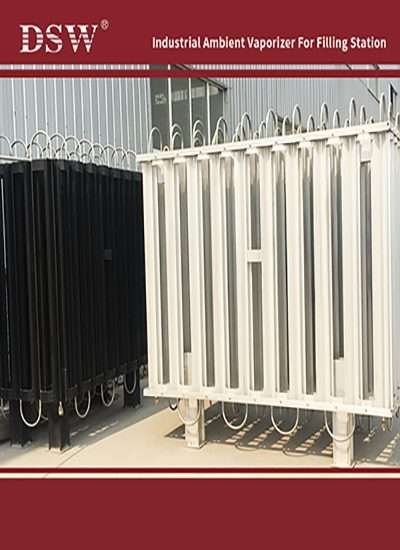
An ambient air vaporizer is a cryogenic heat exchanger that converts liquefied gases into gas by transferring heat from the surrounding atmosphere. It uses natural ambient air as the primary heat source, so it normally does not require electricity, steam, or a circulating water bath for the vaporization process.
Ambient air vaporizers are widely used to convert cryogenic liquids such as liquid nitrogen (LIN), liquid oxygen (LOX), liquid argon (LAr), liquefied natural gas (LNG), and liquid carbon dioxide (LCO₂) into gaseous products for industrial gas supply systems, process plants, energy applications, and other gas-consuming facilities.
The appropriate ambient air vaporizer depends on the gas, liquid flow rate, inlet and outlet conditions, operating pressure, ambient temperature, allowable pressure drop, and required continuous or intermittent gas demand.
How Does an Ambient Air Vaporizer Work?
The working principle of an ambient air vaporizer is based on natural heat transfer from atmospheric air to a cryogenic liquid.
When a cryogenic liquid enters the vaporizer, it passes through heat-transfer tubes or specially designed finned tubes. Because the surrounding air is significantly warmer than the cryogenic fluid, heat naturally flows from the air into the vaporizer surface and then into the liquid.
As the cryogenic liquid absorbs heat, it first warms and then changes phase from liquid to gas. The resulting gas continues through the outlet and can be supplied to downstream equipment.
A typical process can be simplified as:
Cryogenic liquid → Heat absorption from ambient air → Vaporization → Gas outlet
Unlike an electric vaporizer or water-bath vaporizer, an ambient air vaporizer does not normally require an external heating medium. This makes the system relatively simple and energy-efficient for suitable operating conditions.
Main Components of an Ambient Air Vaporizer
The exact construction varies according to gas service, capacity, pressure, materials, and applicable design standards. A typical ambient air vaporizer includes the following components:
Heat-Transfer Tubes
The tubes provide the flow path for the cryogenic liquid and gas while transferring heat from the surrounding air. Aluminum is commonly used for finned heat-transfer sections because of its thermal conductivity and suitability for cryogenic applications.
Fins
Fins increase the external surface area exposed to ambient air. A larger effective surface area improves natural heat transfer and allows the vaporizer to achieve the required gasification capacity without an external heating source.
Headers and Manifolds
Headers distribute the cryogenic fluid between multiple heat-transfer circuits. Their design affects flow distribution, pressure drop, mechanical strength, and overall vaporizer performance.
Support Structure
The supporting frame keeps the heat-transfer sections stable and provides the required mechanical support for installation and operation. The structure is selected according to the vaporizer size, operating environment, and installation configuration.
What Gases Can an Ambient Air Vaporizer Handle?
Ambient air vaporizer designs can be used for several cryogenic gases. However, the materials, heat-transfer design, pressure rating, and operating parameters must be selected according to the properties of the specific gas.
| Cryogenic Gas | Common Abbreviation | Typical Applications |
|---|---|---|
| Liquid Nitrogen | LIN | Inerting, purging, blanketing, food processing, electronics and industrial processes |
| Liquid Oxygen | LOX | Medical oxygen, metal cutting, combustion processes and industrial oxygen supply |
| Liquid Argon | LAr | Welding, metal processing, inerting and specialty industrial applications |
| Liquefied Natural Gas | LNG | Natural gas supply, fuel gas systems and energy applications |
| Liquid Carbon Dioxide | LCO₂ | Food processing, beverage applications, industrial processes and gas supply systems |
Not every ambient vaporizer is suitable for every cryogenic fluid. The vaporizer should be specifically engineered for the intended gas and operating conditions.
Types of Ambient Air Vaporizers
Ambient vaporizers can be classified according to their construction, capacity, installation arrangement, and application.
Natural Draft Ambient Vaporizer
A natural-draft ambient vaporizer relies on the natural movement of surrounding air. Its finned tubes provide a large heat-transfer surface, allowing atmospheric heat to vaporize the cryogenic liquid.
This design is suitable for applications where the available ambient temperature and natural convection provide sufficient heat-transfer capacity.
Forced-Air Vaporizer
A forced-air vaporizer uses fans or blowers to increase airflow across the heat-transfer surfaces. Forced airflow can improve heat transfer and provide greater control over vaporization capacity, although it introduces additional equipment and power requirements.
High-Pressure Ambient Vaporizer
High-pressure ambient vaporizers are designed for applications where the cryogenic fluid must be vaporized while maintaining a relatively high operating pressure. The pressure rating, tube design, headers, connections, and applicable pressure-vessel or piping requirements must be considered during engineering.
Multiple-Section Ambient Vaporizer
For larger gas demands, multiple heat-transfer sections can be connected in parallel. This arrangement increases the available heat-transfer area and can provide greater vaporization capacity while allowing the system to be configured around the required flow rate and installation space.
Applications
Ambient air vaporizers are commonly integrated into cryogenic gas supply systems where a stored liquid needs to be converted into a usable gas before entering the downstream process.
Industrial Gas Supply
Industrial gas plants use ambient vaporizers to convert stored LIN, LOX, and LAr into gaseous nitrogen, oxygen, and argon for manufacturing and process applications.
Chemical and Petrochemical Plants
Nitrogen and other industrial gases are used for inerting, purging, blanketing, pressure control, and process operations. An ambient vaporizer can provide the required gas from a cryogenic liquid storage system.
Metal Fabrication
Oxygen and nitrogen gas are widely used in cutting, heating, welding, and metal-processing operations. Ambient vaporizers can be connected to bulk cryogenic storage systems to provide a continuous gaseous supply.
Food and Beverage Processing
Nitrogen and carbon dioxide are used in food processing, packaging, chilling, and beverage applications. The required vaporizer capacity depends on gas consumption, peak demand, operating pressure, and the process requirements.
LNG and Natural Gas Systems
Ambient vaporizers can convert LNG into natural gas for fuel-gas and energy applications. LNG service requires careful consideration of cryogenic temperatures, material compatibility, flow rate, pressure, and the required outlet conditions.
Advantages of Ambient Air Vaporizers
- No continuous external heating source: The vaporizer uses heat naturally available in the surrounding atmosphere.
- Low operating energy consumption: Natural-draft designs generally do not require electrical heating.
- Simple operating principle: The system uses passive heat transfer between ambient air and the cryogenic fluid.
- Low routine operating complexity: Compared with systems using electric heaters or water circulation, the basic heat-transfer system has fewer active components.
- Suitable for bulk cryogenic gas supply: Ambient vaporizers can be integrated with cryogenic storage tanks and downstream gas distribution systems.
- Modular capacity: Multiple heat-transfer sections can be configured for different flow requirements.
Limitations of Ambient Air Vaporization
Although ambient air vaporization is energy-efficient, it is not suitable for every operating condition.
Ambient Temperature Affects Capacity
The vaporizer depends on heat from the surrounding air. Lower ambient temperatures reduce the available temperature difference and can therefore reduce vaporization capacity.
Frost Formation
During vaporization, moisture from atmospheric air can freeze on the external heat-transfer surfaces. Frost accumulation can reduce effective heat transfer and may require an operating strategy that allows the vaporizer to recover.
Continuous High Demand
Applications with high and continuous gas consumption may require multiple vaporizer sections or a supplemental heating system. The design should be based on the required continuous and peak flow rates rather than nominal vaporizer capacity alone.
Pressure Drop
The vaporizer must provide sufficient heat-transfer capacity while maintaining an acceptable pressure drop. Tube diameter, tube length, circuit arrangement, flow velocity, and operating pressure all affect system performance.
Ambient Air Vaporizer vs. Electric and Water-Bath Vaporizers
Ambient air, electric, and water-bath vaporizers convert cryogenic liquids into gas, but they differ in heat source, energy consumption, operating characteristics, and suitable applications. Understanding these differences helps determine the right vaporizer for industrial gas supply systems based on required flow rate, operating conditions, and energy availability.
| Feature | Ambient Air Vaporizer | Electric Vaporizer | Water-Bath Vaporizer |
|---|---|---|---|
| Heat source | Surrounding air | Electric heating elements | Heated water or another heat-transfer medium |
| Vaporization capacity | Available in different capacities; output depends on ambient conditions, frost accumulation, and design | Configured to meet specified flow rates and heating requirements | Designed for specified flow rates, including demanding continuous-duty applications |
| External energy | Normally requires no external heating energy during natural-draft operation | Requires electricity | Requires energy to heat the water or heat-transfer medium |
| Operating complexity | Relatively simple, with periodic inspection and defrost management as needed | Requires electrical controls, heating elements, and appropriate safety protection | Requires temperature control and, depending on design, circulation and water-system maintenance |
| Ambient-temperature dependence | High; performance is affected by air temperature, humidity, and frost formation | Generally low, provided electrical heating capacity is sufficient | Generally lower when the heating system can maintain the required operating temperature |
| Typical application | Bulk liquid oxygen, nitrogen, or argon supply where ambient conditions and available space support natural vaporization | Applications requiring controlled heating, compact installation, or more consistent vaporization output | Industrial processes requiring continuous gas supply, higher heat input, or more stable vaporization under demanding operating conditions |
| Main selection consideration | Lowest external energy demand, balanced against climate, frost, and space requirements | Available electrical power, operating costs, and required outlet conditions | Required duty, heat-source availability, temperature control, and maintenance requirements |
How to choose: An ambient air vaporizer is a practical option when low energy consumption is a priority and the surrounding air can provide sufficient heat. An electric vaporizer offers controlled heat input, while a water-bath vaporizer can support demanding applications that require a suitable, controlled heat source. The final choice should account for gas type, required flow rate, inlet pressure, outlet temperature, ambient conditions, and operating duty.
For installations with fluctuating gas demand or low ambient temperatures, a combination of vaporizer types may be appropriate. For example, an ambient air vaporizer can handle normal demand while a supplementary heated vaporizer provides additional capacity when required. The system should be sized according to the expected peak demand and verified operating performance.
How to Select an Ambient Air Vaporizer
Selecting an ambient air vaporizer should start with the process conditions rather than simply choosing a nominal model size.
1. Cryogenic Fluid
Identify the liquid to be vaporized, such as LIN, LOX, LAr, LNG, or LCO₂. Material compatibility and the thermodynamic properties of the fluid must be considered.
2. Required Gas Flow Rate
Determine the normal, peak, and continuous gas consumption. A vaporizer designed only around average demand may not provide sufficient capacity during peak consumption.
3. Inlet Pressure and Outlet Pressure
The operating pressure affects flow characteristics, equipment design, pressure drop, and the overall gas supply system. Specify both inlet and required outlet conditions when requesting a vaporizer quotation.
4. Minimum Ambient Temperature
Because ambient air provides the heat source, the minimum design ambient temperature is an important parameter. The vaporizer should be sized for the expected environmental conditions rather than an average annual temperature.
5. Continuous or Intermittent Operation
Intermittent gas consumption and continuous high-flow operation impose different thermal requirements. Operating cycles should therefore be considered when determining the required heat-transfer area.
6. Allowable Pressure Drop
The vaporizer should be designed so that pressure loss through the heat-transfer circuits remains compatible with the downstream gas supply system.
7. Installation Environment
Available installation space, airflow, weather conditions, maintenance access, foundation requirements, and connection orientation should all be considered before finalizing the design.
Ambient Air Vaporizer Capacity
Vaporizer capacity is not determined by one parameter alone. It depends on the relationship between the cryogenic fluid, heat-transfer area, ambient conditions, flow rate, operating pressure, and required outlet conditions.
For a preliminary selection, the following information is normally required:
- Gas or cryogenic liquid type
- Required gas flow rate
- Maximum and minimum flow rate
- Liquid inlet pressure
- Required gas outlet pressure
- Required outlet temperature
- Minimum ambient temperature
- Normal operating temperature
- Continuous operating time
- Allowable pressure drop
- Installation location and available space
For engineered systems, the manufacturer should verify the required heat-transfer area and operating performance using the actual process conditions.
Ambient Air Vaporizer Maintenance
Ambient vaporizers generally have fewer active components than externally heated vaporization systems, but they still require inspection and maintenance.
Routine inspection should include:
- Checking heat-transfer tubes and fins for damage or deformation
- Inspecting headers, connections, valves, and supports
- Checking for abnormal frost accumulation
- Monitoring pressure drop and outlet conditions
- Inspecting the installation structure and mounting points
- Checking for corrosion or environmental damage
- Verifying that airflow around the vaporizer is not unnecessarily restricted
Maintenance requirements depend on the gas service, operating environment, equipment design, and applicable local regulations.
Ambient Air Vaporizer Manufacturer and OEM Supply
For industrial applications, the vaporizer should be selected and engineered according to the actual gas supply system rather than treated as a standalone heat exchanger.
An experienced ambient vaporizer manufacturer can evaluate the cryogenic fluid, required flow rate, operating pressure, ambient conditions, materials, heat-transfer area, connection requirements, and installation configuration to develop a suitable vaporization solution.
OEM ambient air vaporizer supply can also be configured for integration with cryogenic storage tanks, pressure regulation equipment, gas pipelines, valves, instrumentation, and downstream gas consumption systems.
TECHNICAL FAQs
FAQs About Ambient Air Vaporizer
An ambient air vaporizer is a heat exchanger that converts cryogenic liquid into gas by absorbing heat from the surrounding air. It normally does not require an external heating source for natural-draft operation.
A natural-draft ambient vaporizer normally does not require electricity for the vaporization process. However, an overall gas supply system may still contain electrically powered valves, instruments, controls, pumps, or other auxiliary equipment.
Yes. Ambient air vaporizers are commonly used to convert liquid nitrogen into gaseous nitrogen. The vaporizer must be correctly sized for the required nitrogen flow rate, operating pressure, ambient temperature, and duty cycle.
Yes, ambient vaporizers can be designed for LNG service. LNG applications require appropriate materials, pressure ratings, thermal design, safety systems, and operating procedures because LNG is stored and handled at cryogenic temperatures.
Yes. Ambient air vaporizers can be used for LNG vaporization when the required flow rate, ambient conditions, outlet temperature, and operating duty are suitable. For high continuous LNG regasification duties, heated or hybrid vaporization systems may provide more stable performance.
Frost forms because moisture in the surrounding air can freeze when the vaporizer surface becomes very cold during cryogenic liquid vaporization. Excessive frost can reduce heat transfer and may affect vaporizer capacity.
Vaporizer sizing should consider the cryogenic fluid, required gas flow rate, inlet and outlet pressure, minimum ambient temperature, required outlet temperature, operating cycle, allowable pressure drop, and installation conditions. The final selection should be verified by the vaporizer manufacturer using the actual process requirements.
An ambient vaporizer uses heat naturally available in the surrounding air, while an electric vaporizer uses electrical energy to provide heat. Ambient vaporizers can have lower operating energy requirements, while electrically heated systems can provide more controlled vaporization under conditions where ambient heat is insufficient.
Choose the Right Ambient Air Vaporizer for Your Application
The correct ambient air vaporizer depends on more than nominal gas capacity. Gas type, flow rate, operating pressure, ambient temperature, heat-transfer requirements, pressure drop, operating cycle, and installation conditions all affect the final design.
If you are planning a cryogenic gas supply system, provide your gas type, required flow rate, operating pressure, minimum ambient temperature, and duty requirements. These parameters can be used to determine the appropriate ambient vaporizer configuration and heat-transfer capacity for your application.

No comment