
DSW designs and manufactures cryogenic storage solutions for liquid nitrogen, liquid oxygen, liquid argon, liquid carbon dioxide, LNG, and other liquefied gases. Our systems combine vacuum-insulated cryogenic storage tanks with vaporizers, pressure-control equipment, valves, instrumentation, and gas distribution components to provide reliable on-site gas supply for industrial, medical, food, chemical, energy, and other applications.
A complete cryogenic storage system is more than a storage tank. It is an integrated process that connects storage, vaporization, pressure control, gas distribution, and point of use. DSW can configure storage systems according to gas type, consumption, required capacity, operating pressure, site conditions, applicable standards, and project requirements.
What Is a Cryogenic Storage Solution?
A cryogenic storage solution is an engineered system used to store and supply gases that have been liquefied at extremely low temperatures. Instead of storing these gases only in compressed-gas cylinders, bulk cryogenic systems store the gas as a liquid and convert it back to gas when required.
A typical system consists of a vacuum-insulated cryogenic tank, liquid and gas piping, pressure-control equipment, safety devices, level instrumentation, and a vaporizer when gaseous supply is required. Depending on the application, the system may also include pumps, filling connections, remote monitoring, gas distribution equipment, and other components.
The appropriate configuration depends on the characteristics of the gas and the customer’s consumption profile. A small laboratory may require a compact dewar or microbulk system, while a manufacturing plant with continuous high gas consumption may require a large bulk storage tank with a dedicated vaporization and distribution system.
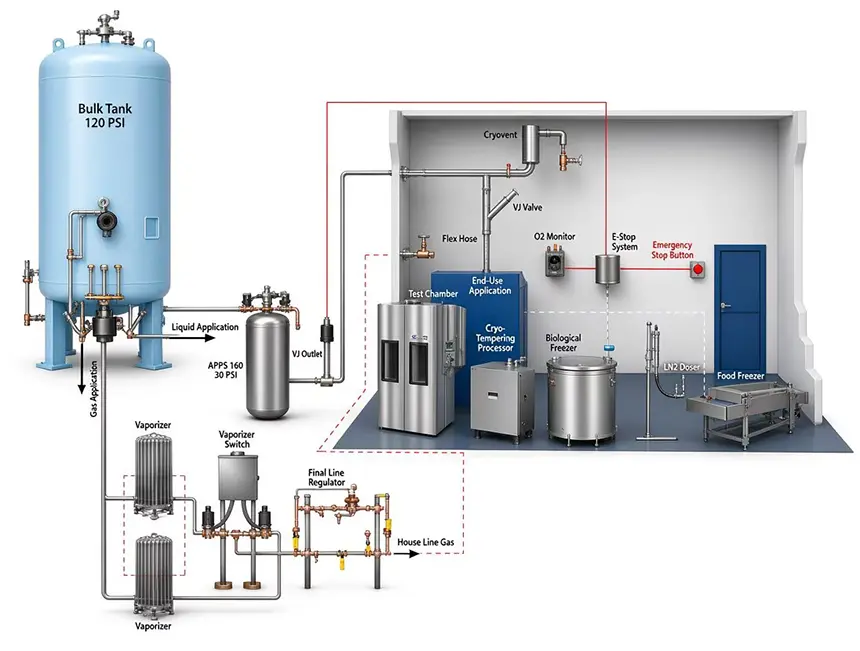
How Does a Cryogenic Storage System Work?
The basic operating process is:
Liquid gas delivery → Cryogenic storage → Pressure control → Vaporization → Gas distribution → Point of use
Liquefied gas is delivered to the storage tank through a suitable filling connection. The vacuum-insulated tank minimizes heat transfer from the surrounding environment and helps maintain the cryogenic liquid at the required storage condition.
When gas is required, liquid can be supplied to a vaporizer, where controlled heat transfer converts the liquid into gas. Pressure-control equipment then regulates the gas before it enters the downstream distribution system.
For applications that use the cryogenic liquid directly, the system can instead provide controlled liquid withdrawal. Instrumentation monitors parameters such as liquid level and pressure so operators can manage inventory and operating conditions.
What Does a Cryogenic Storage System Include?
A complete cryogenic storage solution can contain several integrated components. The exact configuration depends on the gas, capacity, pressure, application, and site requirements.
| System Component | Function |
|---|---|
| Cryogenic Storage Tank | Stores liquefied gas under controlled cryogenic conditions. |
| Vacuum Insulation | Reduces heat transfer and helps minimize liquid evaporation. |
| Pressure Build-Up System | Maintains the required tank operating pressure. |
| Vaporizer | Converts cryogenic liquid into gas for downstream use. |
| Pressure Regulator | Controls downstream gas pressure according to system requirements. |
| Safety Relief Valves | Provides overpressure protection for the cryogenic system. |
| Level Instrumentation | Monitors the amount of cryogenic liquid stored in the tank. |
| Piping and Valves | Controls and transfers cryogenic liquid and gaseous products. |
| Monitoring System | Monitors pressure, level, and other operating conditions. |
Cryogenic Storage Tank
The storage tank is the central component of the system. Cryogenic tanks are designed to maintain liquefied gases at very low temperatures while limiting heat transfer from the environment.
Tank capacity, working pressure, configuration, connections, and instrumentation are selected according to the gas and application. DSW can provide cryogenic tanks in different capacities and configurations for stationary storage and specialized transportation requirements.
For projects requiring customized fabrication, see our cryogenic tank manufacturing capabilities.
Vacuum Insulation
Vacuum insulation is a key part of many cryogenic storage tanks. The vacuum space between the inner and outer vessels significantly reduces heat transfer, helping maintain the low temperature of the stored liquid and reduce boil-off.
Depending on the tank design, insulation may incorporate vacuum, multilayer insulation, perlite, or other suitable insulation systems.
Vaporizer
A cryogenic vaporizer converts cryogenic liquid into gas when the application requires gaseous supply. Vaporizer selection depends on gas type, required gas flow, outlet pressure, ambient conditions, and operating requirements.
DSW can integrate suitable vaporization equipment with cryogenic storage systems to provide a continuous gas supply for downstream applications.
Pressure Control
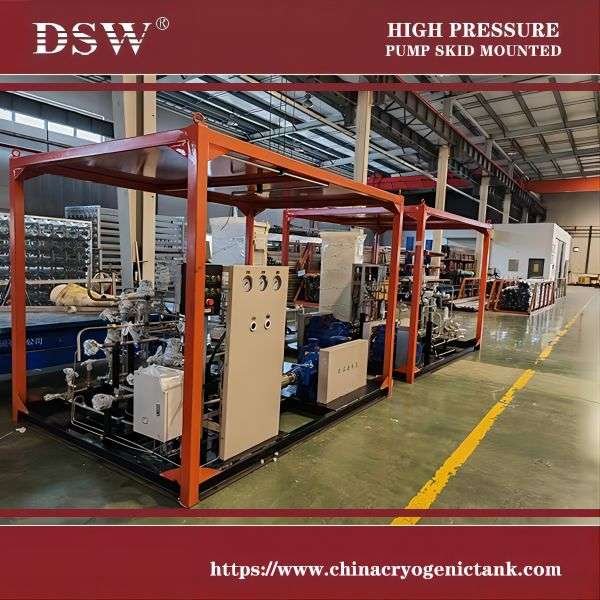
Pressure-control equipment helps maintain stable operating conditions between the storage tank and the gas distribution system. Depending on the system design, this can include pressure build-up circuits, regulators, valves, and associated instrumentation.
Safety and Instrumentation
Cryogenic systems require appropriate safety devices and instrumentation to monitor operating conditions. Pressure relief devices, isolation valves, liquid-level indicators, pressure gauges, and other instruments can be incorporated according to the tank design and project requirements.
Key Components of an Industrial Gas Supply System
An industrial gas supply system is an integrated arrangement of storage, vaporization, pressure control, distribution, safety, and monitoring equipment. Each component should be selected according to the gas service, operating pressure, temperature, flow rate, materials, installation conditions, and applicable regulations.
| Component | Primary Function | Key Selection Considerations |
|---|---|---|
| Gas Storage Tanks | Store industrial gases and provide the operating reserve required by the facility. | Gas type, storage capacity, operating pressure, design temperature, insulation method, site conditions, and applicable standards. |
| Cryogenic Vaporizers | Convert cryogenic liquid into gaseous form before or during delivery to the distribution system. | Continuous flow rate, peak demand, inlet liquid temperature, outlet pressure, ambient conditions, operating hours, and redundancy requirements. |
| Pressure-Building Equipment | Maintains the pressure required for liquid withdrawal and stable operation of a cryogenic storage tank. | Tank operating pressure, liquid withdrawal rate, ambient conditions, pressure requirements, and equipment configuration. |
| Pressure-Control Equipment | Regulates or reduces gas pressure before delivery to downstream equipment and points of use. | Inlet and outlet pressure, flow rate, pressure drop, gas compatibility, control accuracy, and relief protection. |
| Gas Manifolds | Connect multiple cylinders or supply sources to a common gas outlet. | Number of cylinders, gas type, operating pressure, required flow rate, manual or automatic changeover, and continuous-supply requirements. |
| Gas Distribution Piping | Transfers gas from storage, vaporization, or manifold equipment to individual points of use. | Flow rate, pressure drop, pipe length, fittings, gas properties, operating pressure, material compatibility, and future expansion. |
| Valves and Pressure-Relief Devices | Provide isolation, flow control, pressure protection, and emergency shutdown functions. | Gas service, pressure rating, temperature range, equipment design, installation arrangement, and applicable regulations. |
| Instrumentation and Monitoring | Provides operating data, alarms, and system status information for safe operation and maintenance. | Tank level, pressure, temperature, flow, alarm requirements, gas detection, remote monitoring, and automation requirements. |
Cryogenic Storage Solutions by Type
Different users require different storage configurations. DSW provides cryogenic storage solutions ranging from compact storage vessels to bulk systems designed for continuous industrial gas supply.
Bulk Cryogenic Storage
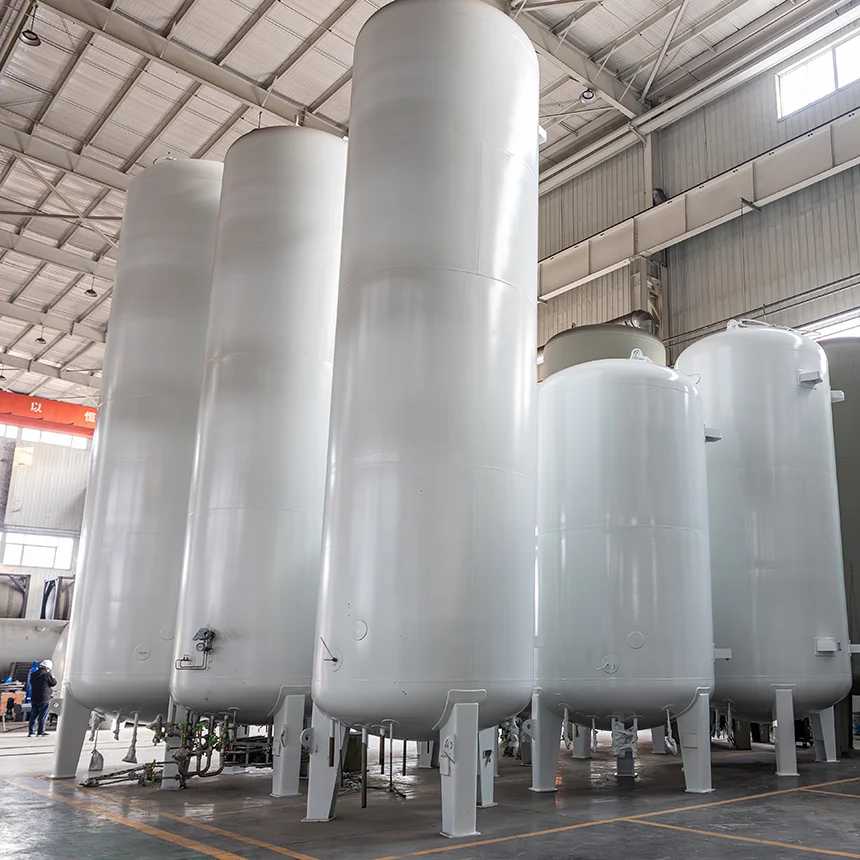
Bulk cryogenic storage systems are designed for facilities with relatively high or continuous consumption of liquefied gases. A bulk system can reduce dependence on frequent cylinder replacement and provide a centralized source of liquid or gaseous product.
Typical gases include liquid nitrogen, liquid oxygen, liquid argon, and liquid carbon dioxide. A bulk system may combine a stationary storage tank, vaporizer, pressure-control equipment, and gas distribution piping.
These systems are commonly used in manufacturing plants, chemical facilities, food-processing facilities, medical applications, laboratories, and other operations requiring a reliable gas supply.
Microbulk Storage Systems
Microbulk storage systems provide an intermediate solution between individual cylinders or dewars and larger bulk storage installations. They are suitable for users with moderate gas consumption who require an on-site liquid gas supply.
A microbulk system can provide improved supply continuity while reducing the handling of individual cylinders. Typical applications include industrial facilities, laboratories, medical centers, food processing, and other locations with regular but moderate demand.
Explore cryogenic microbulk tanks for more information about available equipment.
LNG Storage Systems
LNG storage systems are designed specifically for liquefied natural gas applications. LNG is stored as a cryogenic liquid and requires appropriate tank construction, insulation, pressure control, safety equipment, and transfer connections.
Depending on the project, LNG storage can be configured for fuel supply, industrial energy applications, transportation, or other specialized uses. Tank capacity, pressure, installation configuration, and applicable requirements should be determined during system engineering.
View LNG cryogenic tanks for more information.
Cryogenic Dewar Storage
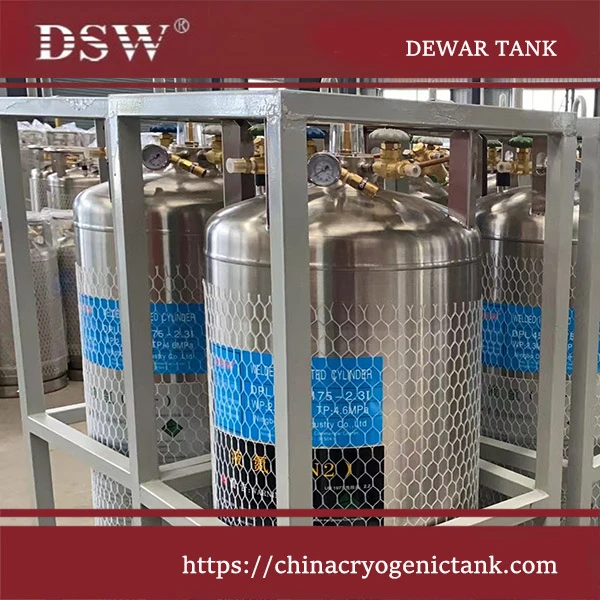
Cryogenic dewars are generally used for smaller storage volumes and applications where a compact or portable supply is required. They can be used to store and transport cryogenic liquids such as liquid nitrogen and liquid oxygen, depending on the vessel design.
Dewars are commonly used in laboratories, healthcare, research, food processing, and smaller industrial applications where bulk storage may not be necessary.
Cryogenic Storage Solutions by Gas
The gas being stored is one of the most important factors when selecting a cryogenic storage system. Different gases have different boiling points, operating requirements, applications, and safety considerations.
| Gas | Typical Storage System | Common Applications |
|---|---|---|
| Liquid Nitrogen (LN₂) | Bulk or microbulk cryogenic tanks | Manufacturing, food processing, electronics, laboratories |
| Liquid Oxygen (LOX) | Bulk oxygen storage tanks | Medical and industrial oxygen supply |
| Liquid Argon (LAr) | Bulk or microbulk storage tanks | Welding, metallurgy, manufacturing |
| Liquid CO₂ (LCO₂) | CO₂ storage tanks | Food and beverage, industrial processing, refrigeration |
| LNG | LNG cryogenic storage tanks | Energy, fuel supply, industrial applications |
| Liquid Hydrogen (LH₂) | Specialized cryogenic storage systems | Energy, research, aerospace, specialized applications |
Liquid Nitrogen Storage
Liquid nitrogen is widely used for inerting, cooling, food freezing, electronics manufacturing, metal processing, and laboratory applications. Depending on consumption, LN₂ can be stored in dewars, microbulk tanks, or larger bulk cryogenic storage tanks.
For continuous gaseous nitrogen supply, the storage tank can be connected to a suitable vaporizer and pressure-control system.
Liquid Oxygen Storage
Liquid oxygen storage systems are used where larger quantities of oxygen are required for medical or industrial applications. The system configuration must account for oxygen service requirements, storage capacity, operating pressure, safety equipment, and applicable standards.
Liquid Argon Storage
Liquid argon is used in welding, metallurgy, metal fabrication, and other industrial processes. Bulk or microbulk storage can provide a centralized argon supply for facilities with regular consumption.
Liquid CO₂ Storage
Liquid carbon dioxide is used in food and beverage processing, industrial applications, refrigeration, and other processes. CO₂ storage systems can be configured with suitable storage tanks, pressure-control equipment, and downstream distribution equipment.
LNG Storage
LNG storage systems provide on-site storage of liquefied natural gas for applications requiring a cryogenic fuel supply. The storage system can be designed around required capacity, operating pressure, filling arrangements, site conditions, and applicable project standards.
Liquid Hydrogen Storage
Liquid hydrogen requires specialized cryogenic storage technology because of its extremely low temperature and unique physical properties. Storage systems for hydrogen applications require careful consideration of insulation, materials, pressure management, safety, and project-specific engineering requirements.
How to Select a Cryogenic Storage System
Choosing a cryogenic storage system should start with the application and gas consumption profile rather than tank capacity alone. The storage tank, vaporizer, pressure-control equipment, and distribution system need to work together as a complete system.
Important selection factors include:
- Gas type: Identify the liquefied gas to be stored and its service requirements.
- Daily consumption: Estimate the normal amount of gas or liquid used by the facility.
- Peak demand: Determine the maximum instantaneous or hourly gas requirement.
- Required storage capacity: Select sufficient capacity for normal operation and the desired supply reserve.
- Operating pressure: Establish the tank working pressure and required downstream pressure.
- Reserve time: Determine how long the facility needs to operate between deliveries.
- Filling frequency: Consider delivery schedules and the available logistics arrangement.
- Installation space: Evaluate the available footprint, access, piping routes, and installation conditions.
- Environmental conditions: Consider ambient temperature, weather exposure, altitude, and other site conditions.
- Applicable standards: Identify the standards and certification requirements for the destination market and application.
- Transportation requirements: Determine whether the system is stationary, mobile, or intended for cryogenic transportation.
- Downstream gas pressure: Select vaporization and pressure-control equipment according to the required point-of-use conditions.
Cryogenic Tank Capacity and System Sizing
Cryogenic tank capacity should be determined from the facility’s gas consumption, peak demand, required reserve time, and delivery frequency. A tank that is too small may require frequent refilling, while excessive storage capacity may increase equipment and installation costs without providing a corresponding operational benefit.
Engineers also consider vaporizer capacity, operating pressure, boil-off rate, filling arrangements, site conditions, and downstream gas requirements when configuring the complete system.
For a customized recommendation, provide DSW with the gas type, required storage capacity or consumption, working pressure, application, installation location, and destination country. These parameters allow the storage tank and associated equipment to be evaluated as one system.
Cryogenic Tank Construction & Insulation
Cryogenic storage tanks are engineered to maintain liquefied gases at low temperatures while controlling heat transfer and mechanical stresses. A typical vacuum-insulated tank includes an inner vessel, outer vessel, insulation system, support structure, piping, valves, and instrumentation.
Inner Vessel
The inner vessel is in direct contact with the cryogenic liquid. Material selection depends on the stored gas, operating temperature, pressure, tank configuration, and applicable design requirements.
Outer Vessel
The outer vessel surrounds the insulated inner vessel and forms part of the vacuum-insulated structure. Its design protects the insulation space and supports the overall tank configuration.
Vacuum Jacket
The vacuum space between the inner and outer vessels reduces heat transfer and is an important part of the insulation system used in many cryogenic storage tanks.
Insulation System
Depending on the tank design, insulation can incorporate vacuum, multilayer insulation, perlite, or other suitable materials and configurations. The objective is to reduce heat ingress and maintain the required cryogenic storage conditions.
Piping, Valves and Supports
Internal and external piping, valves, supports, filling connections, withdrawal connections, pressure-control circuits, and safety devices are configured according to the tank design and application.
Looking for a Cryogenic Storage Solution?
Tell us your gas type, consumption, pressure, and storage requirements to discuss the right solution for your project.
Applications of Cryogenic Storage Systems
Cryogenic storage systems are used across industries that require reliable supplies of liquefied gases or their vaporized forms.
How to Select an Industrial Gas Supply System
The correct configuration depends on the relationship between gas consumption, storage capacity, supply logistics, pressure requirements, site conditions, and required continuity.
| Application | Typical Gases | Typical Equipment | System Requirement |
|---|---|---|---|
| Industrial Gas Supply | LN₂, LAr, LOX | Bulk tank + vaporizer | Continuous gas supply |
| Food Processing | LN₂, CO₂ | Cryogenic tank + vaporizer | Cooling, freezing or processing gas supply |
| Medical Facilities | LOX, LN₂ | Bulk or microbulk tank | Reliable on-site gas supply |
| Metal Fabrication | LAr, CO₂, O₂ | Bulk or microbulk storage | Welding and metal-processing gas |
| Chemical Processing | LN₂, O₂, Ar | Bulk tank + gas distribution | Inerting, oxidation and process gas supply |
| Electronics Manufacturing | LN₂, Ar | Bulk storage + vaporizer | High-reliability process gas |
| Energy | LNG | LNG storage system | Fuel storage and supply |
| Research and Laboratories | LN₂, LAr, LH₂ | Dewars, microbulk or specialized tanks | Controlled cryogenic supply |
| Aerospace | LN₂, LOX, LH₂ | Specialized cryogenic systems | Specialized storage and handling |
Cryogenic Storage Standards & Certification
Cryogenic storage systems may be subject to different design, manufacturing, testing, and certification requirements depending on the gas, tank type, destination market, operating conditions, and project specifications.
Depending on the application and destination, applicable requirements may include ASME, PED, EN, ISO, GB/T, and other national or international standards.
Standards and certifications should be evaluated for the specific tank and project rather than treated as a universal list. DSW can work with customers to identify the applicable requirements for the intended market and application.
DSW Cryogenic Storage Engineering
DSW approaches cryogenic storage as a complete equipment and engineering requirement rather than simply supplying an individual tank. The system can be configured around the customer’s gas consumption, storage requirements, operating conditions, and installation environment.
System Design
DSW evaluates gas type, capacity, pressure, consumption, reserve requirements, equipment configuration, and applicable standards to develop an appropriate cryogenic storage arrangement.
Manufacturing
DSW manufactures cryogenic tanks and associated equipment for industrial gas storage and supply applications. Manufacturing requirements are established according to the tank design, material requirements, applicable standards, and customer specifications.
Testing and Quality Control
Testing and inspection requirements are determined according to the tank design, applicable standards, and project specifications. Appropriate inspections and tests help verify the integrity and performance of the finished equipment.
Certification
Where required, DSW can work with customers on the applicable certification and documentation requirements for the target market and project.
Delivery and Installation Support
Cryogenic equipment can involve specialized transportation, site access, connection requirements, and installation considerations. DSW can coordinate equipment configuration and technical documentation according to the project requirements.
Related Cryogenic Equipment
A complete cryogenic storage system may require additional equipment depending on the application.
- Cryogenic storage tanks for bulk liquid storage
- Cryogenic microbulk tanks for medium-consumption applications
- LNG storage tanks for liquefied natural gas
- Cryogenic tank containers for specialized transport and storage requirements
- Cryogenic vaporizers for converting liquid gas into gaseous product
- Pressure-control equipment for maintaining required operating pressure
- Valves, piping and instrumentation for liquid and gas handling
TECHNICAL FAQs
FAQs About Cryogenic Storage Solutions
Tank capacity should be evaluated from gas type, daily consumption, peak demand, required reserve time, delivery frequency, operating pressure, and site conditions. DSW can assess these parameters to help determine a suitable storage configuration.
The most useful information includes gas type, daily or monthly consumption, peak demand, required storage capacity, working pressure, required outlet pressure, application, installation location, destination country, and applicable certification requirements.
Bulk storage systems are generally intended for higher-consumption facilities and larger storage requirements. Microbulk systems provide an intermediate solution for users with moderate consumption who need an on-site liquid gas supply.
A system may include a cryogenic storage tank, vacuum insulation, pressure build-up equipment, vaporizer, pressure regulators, safety valves, level instrumentation, piping, valves, and monitoring equipment. The exact configuration depends on the application.
Vacuum insulation reduces heat transfer from the surrounding environment into the cryogenic liquid. Lower heat ingress helps maintain the required storage conditions and can reduce unwanted evaporation of the stored liquid.
Refilling frequency depends on tank capacity, gas consumption, peak demand, operating conditions, and the supply arrangement. A larger storage capacity relative to consumption generally provides a longer interval between deliveries, subject to the specific system design.
Yes. Cryogenic storage equipment can be configured according to gas type, storage capacity, working pressure, application, site conditions, and destination-market requirements. Customers should provide project parameters so the appropriate equipment configuration can be evaluated.
Applicable standards depend on the gas, tank type, destination market, operating conditions, and project requirements. Depending on the application, requirements may include ASME, PED, EN, ISO, GB/T, and other applicable standards.
Yes. A cryogenic storage system can be configured with a vaporizer, pressure-control equipment, valves, instrumentation, and other gas-handling components when gaseous product is required at the point of use.
Request a Cryogenic Storage System Proposal
Choosing the right cryogenic storage system requires more than selecting a tank volume. The storage capacity, gas type, consumption profile, operating pressure, vaporizer capacity, reserve requirements, and site conditions should be considered together.
DSW can help evaluate the equipment configuration for your application and provide a cryogenic storage solution based on your project requirements.
When requesting a proposal, please provide:
- Gas type
- Required storage capacity
- Daily and peak consumption
- Working pressure
- Required outlet pressure
- Application
- Installation location
- Destination country
- Required standard or certification
Looking for a reliable cryogenic storage solution? Contact DSW to discuss your storage, vaporization, pressure-control, and gas supply requirements.