
Custom Vacuum-Insulated Cryogenic Storage Tanks
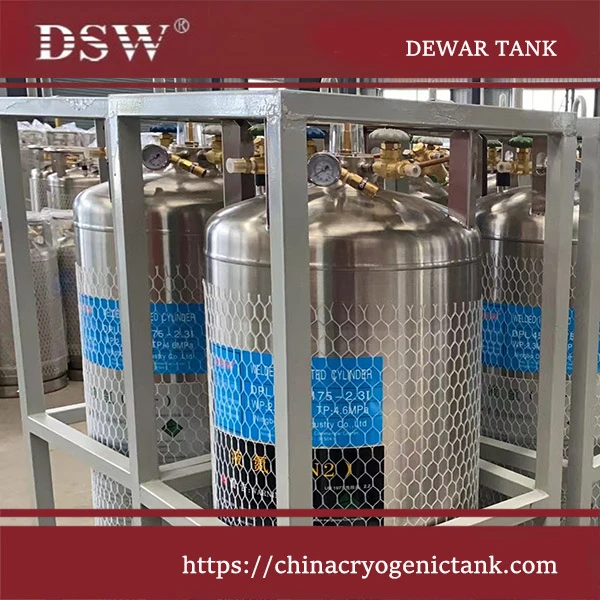
DSW Industry manufactures vacuum-insulated cryogenic storage tanks and pressure vessels for liquefied nitrogen, oxygen, argon, carbon dioxide, LNG and other compatible cryogenic media. We provide engineered solutions for industrial gas storage, medical gas supply, energy, chemical processing, food and beverage, laboratories and other applications.
- LIN / LN₂, LOX, LAr, LCO₂ and LNG applications
- Vacuum-insulated double-wall construction
- Vertical and horizontal tank configurations
- Application-specific capacity, pressure and connection configurations
- ASME, PED, EN, GB and project-specific requirements, where applicable
- OEM manufacturing and international project support
Cryogenic Tank Manufacturing for Industrial Gas Storage
DSW Industry manufactures and supplies vacuum-insulated cryogenic tanks and vessels designed for the storage and handling of liquefied gases at cryogenic temperatures. Our tanks are engineered according to the stored medium, required capacity, working pressure, operating conditions, installation environment and applicable design or certification requirements.
Typical cryogenic media include liquid nitrogen (LIN/LN₂), liquid oxygen (LOX), liquid argon (LAr), liquid carbon dioxide (LCO₂) and LNG. Depending on the application, tanks can be supplied in vertical or horizontal configurations with customized piping, valves, instrumentation, pressure-building systems and filling or discharge connections.
Our manufacturing scope covers engineering and fabrication, material preparation, vessel welding, vacuum insulation, inspection, pressure and leak testing, final assembly and technical documentation.
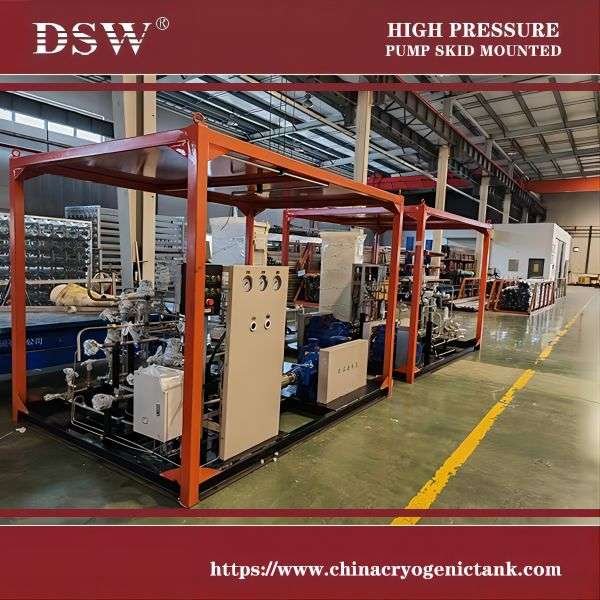
For bulk industrial gas applications, cryogenic storage tanks can also be integrated with vaporizers, cryogenic pumps and downstream gas supply systems to provide a complete gas storage and distribution solution.
Cryogenic Tank Manufacturing Capabilities
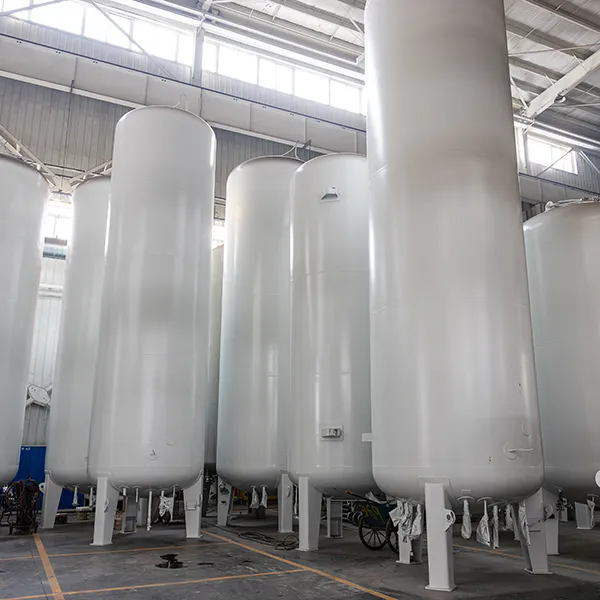
DSW Industry combines pressure-vessel fabrication with cryogenic insulation and equipment integration. Manufacturing and engineering capabilities can include:
- Pressure vessel fabrication: Fabrication of inner and outer vessels for vacuum-insulated cryogenic equipment.
- Stainless-steel fabrication: Cryogenic inner vessels manufactured from suitable low-temperature materials such as 304/304L stainless steel, according to the design.
- Welding and fabrication: Controlled welding processes for pressure-retaining components and cryogenic service.
- Vacuum insulation: Vacuum spaces using perlite or multilayer insulation systems, depending on the tank design.
- Inspection and testing: Dimensional inspection, weld inspection, non-destructive testing, pressure testing, leak testing and vacuum-related testing as required.
- Equipment integration: Piping, valves, gauges, safety devices, pressure-building systems and other cryogenic components can be configured according to the application.
- OEM manufacturing: Custom configurations can be manufactured according to customer drawings, specifications and project requirements.
Manufacturing documentation and inspection requirements can be coordinated according to the applicable code, customer specification and destination-market requirements.
Cryogenic Tanks We Manufacture
Vertical Cryogenic Storage Tanks
Vertical vacuum-insulated storage tanks are designed for stationary bulk storage where available installation space favors a vertical configuration. They are commonly used for liquid nitrogen, oxygen, argon and carbon dioxide storage.
Horizontal Cryogenic Storage Tanks
Horizontal cryogenic tanks provide an alternative configuration for installations with specific height, foundation or access requirements. Tank dimensions, connections and support structures can be adapted to the project.
LNG Storage Tanks
DSW Industry manufactures vacuum-insulated LNG storage equipment for applications requiring controlled storage and transfer of liquefied natural gas. LNG tank design depends on capacity, pressure, installation conditions, applicable codes and project requirements.
Microbulk Cryogenic Tanks
Microbulk tanks provide on-site storage for users with continuous or regular demand for cryogenic gases. They can be configured with appropriate filling, liquid withdrawal, gas outlet, pressure-building and instrumentation systems.
Transport and ISO Cryogenic Tanks
Transport and ISO cryogenic tanks are designed for the storage and transportation of liquefied gases. Their design must account for transport conditions, pressure requirements, applicable transport regulations and the destination market.
Custom Cryogenic Vessels
For specialized projects, DSW Industry can manufacture custom cryogenic vessels according to specified dimensions, capacity, pressure, connections, insulation requirements, materials and applicable engineering standards.
Cryogenic Tank Manufacturing Specifications
| Specification | Typical Configuration |
|---|---|
| Storage Medium | LIN / LN₂, LOX, LAr, LCO₂, LNG and compatible cryogenic liquids |
| Tank Type | Vacuum-insulated double-wall pressure vessel |
| Orientation | Vertical or horizontal |
| Inner Vessel | 304/304L stainless steel or other specified cryogenic material |
| Outer Vessel | Carbon steel or other structural material according to design |
| Insulation | Vacuum insulation with perlite or multilayer insulation, according to design |
| Capacity | Application-dependent and engineered to project requirements |
| Working Pressure | Specified according to medium, operating conditions and applicable design code |
| Design Temperature | Cryogenic service; temperatures approaching −196°C may apply for liquid nitrogen service |
| Design Code | ASME, EN, GB or other applicable requirements |
| Testing | Pressure, leak, vacuum, weld and other inspections according to design and project requirements |
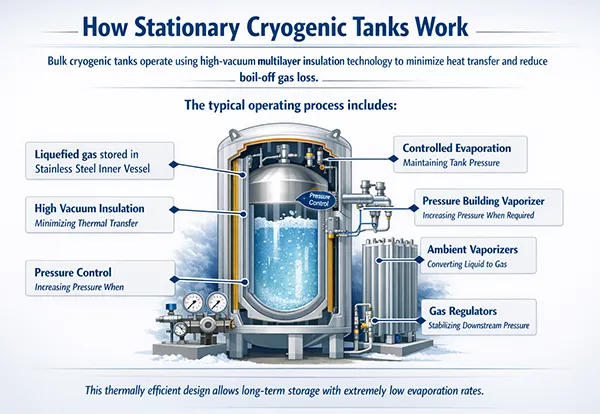
Materials and Vacuum Insulation
Cryogenic tanks require materials and insulation systems suitable for extremely low operating temperatures. The inner vessel is commonly manufactured from stainless steel or another material specified for cryogenic service, while the outer vessel provides structural protection and contains the insulation system.
The space between the inner and outer vessels is evacuated to reduce heat transfer. Depending on the tank design, perlite insulation or multilayer insulation (MLI) may be used within the vacuum space.
Effective vacuum insulation reduces heat ingress and helps limit liquid evaporation during storage. The insulation system, vacuum performance and vessel construction must be considered together when designing a cryogenic storage tank.
Cryogenic Tank Components
A cryogenic storage tank is more than the pressure vessel itself. Its piping and instrumentation must be configured for safe filling, storage, pressure control and liquid or gas withdrawal.
- Filling and liquid withdrawal connections
- Gas outlet and vapor return connections
- Pressure-building system
- Economizer or pressure-control system
- Safety relief valves
- Isolation valves and cryogenic piping
- Pressure gauges and transmitters
- Liquid-level measurement system
- Vacuum gauge or vacuum service connection
- Vaporizer connection
- Drain and vent connections
- Project-specific instrumentation and control components
Component selection depends on the stored medium, operating pressure, required flow rate, installation arrangement and applicable safety requirements.
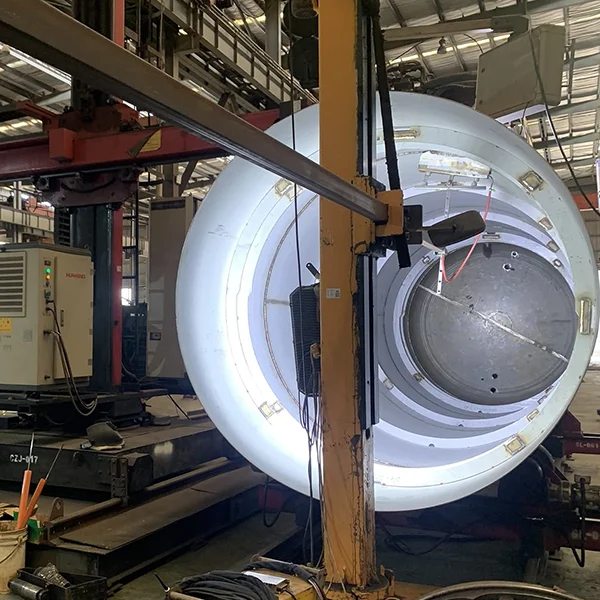
Cryogenic Tank Manufacturing Process
1. Engineering & Design
The manufacturing process begins with the required gas, capacity, working pressure, design temperature, installation conditions, connections, insulation system and applicable design standards.
2. Material Preparation
Specified materials are prepared and verified according to the approved design and manufacturing requirements. Material identification and traceability are maintained where required.
3. Vessel Fabrication
The inner and outer vessels are fabricated according to approved drawings and manufacturing procedures. Dimensional control is maintained throughout fabrication.
4. Welding & Inspection
Pressure-retaining components are welded using controlled procedures. Welds and fabricated components are inspected using applicable visual, dimensional and non-destructive examination methods.
5. Vacuum & Pressure Testing
Completed vessels undergo applicable pressure, leak and vacuum testing. Testing verifies the integrity of the pressure boundary and insulation system before final completion.
6. Final Inspection & Delivery
Final inspection covers vessel condition, dimensions, valves, instrumentation, safety devices, identification and documentation. Equipment is then prepared for shipment according to the project and transport requirements.
Quality Control and Cryogenic Tank Testing
Quality control is integrated throughout the cryogenic tank manufacturing process rather than performed only at final inspection.
- Material verification and traceability
- Welding procedure and fabrication control
- Visual and dimensional inspection
- Non-destructive testing where specified
- Pressure testing
- Leak testing
- Vacuum testing and monitoring
- Safety-device and valve inspection
- Final assembly and functional inspection
- Inspection records and project documentation
The exact inspection and testing program depends on the tank design, applicable code, customer specification and certification requirements.
International Standards and Compliance
Cryogenic tank design and manufacturing requirements vary according to the equipment type, stored medium, pressure, installation conditions, transport application and destination market. DSW Industry can work according to applicable requirements such as:
- ASME Boiler and Pressure Vessel Code, where applicable
- EN standards for applicable pressure equipment
- PED requirements for applicable equipment placed on the European market
- GB / Chinese pressure-vessel standards
- ADR requirements for applicable transport equipment
- ISO quality-management requirements where relevant to the project
- Customer-specific inspection, testing and documentation requirements
Applicable standards should be confirmed during engineering because a particular code or conformity requirement may depend on the tank type, pressure, medium, installation and destination.
How to Select a Cryogenic Storage Tank
Choosing a cryogenic storage tank requires more than selecting a nominal tank capacity. The complete operating and installation requirements should be evaluated before manufacturing.
- Stored medium: Determine whether the application uses LIN/LN₂, LOX, LAr, LCO₂, LNG or another cryogenic liquid.
- Required capacity: Consider normal consumption, peak demand, delivery frequency and required reserve.
- Working and design pressure: Select pressure ratings based on the operating system and applicable code.
- Operating temperature: Confirm the minimum design temperature for the stored medium.
- Tank orientation: Choose vertical or horizontal construction according to available space and installation requirements.
- Filling and withdrawal: Define filling connections, liquid outlets, gas outlets and required flow rates.
- Pressure control: Determine whether a pressure-building system, economizer or other pressure-control arrangement is required.
- Vaporization: Consider whether the storage tank will be connected to an ambient or other cryogenic vaporizer.
- Safety and instrumentation: Specify relief valves, pressure measurement, level measurement and other required controls.
- Applicable standards: Identify the design, inspection, certification and transport requirements for the destination market.
- Installation conditions: Confirm foundation, access, maintenance clearance, piping layout and site restrictions.
Providing these details at the quotation stage helps the manufacturer develop a more accurate tank configuration and technical proposal.
Cryogenic Tank Applications
Industrial Gas Supply
Cryogenic storage tanks provide bulk storage for industrial gases and can be connected to vaporizers and downstream gas distribution systems for continuous supply.
Medical Oxygen
LOX storage tanks can support centralized oxygen supply systems in healthcare facilities and other applications requiring a continuous source of liquid oxygen.
LNG and Energy
LNG tanks are used for storage and supply applications where natural gas is handled in its liquefied state. Tank configuration depends on the project capacity, pressure and applicable regulations.
Food and Beverage
Nitrogen, carbon dioxide and other cryogenic gases are used in food processing, freezing, packaging and beverage applications. Storage tanks support reliable bulk gas availability.
Chemical and Manufacturing
Cryogenic gases are used for inerting, blanketing, cooling, process control and other manufacturing operations. Storage systems can be configured for the required operating conditions.
Laboratories and Research
Research facilities and laboratories use liquid nitrogen and other cryogenic media for sample preservation, cooling and specialized experimental processes.
Cryogenic Storage Tank vs Cryogenic Vessel vs Dewar
| Equipment | Typical Use | Typical Characteristics |
|---|---|---|
| Cryogenic Storage Tank | Bulk stationary storage | Vacuum-insulated, double-wall construction; larger storage capacity |
| Cryogenic Vessel | General engineered cryogenic storage or transport | May refer to different pressure-vessel configurations depending on the application |
| Cryogenic Dewar | Small-volume storage and handling | Typically smaller and intended for laboratory, medical or local handling applications |
The correct equipment depends on the required storage volume, withdrawal rate, mobility, pressure, installation environment and operating requirements.
Looking for a Custom Cryogenic Tank?
Send us your gas type, capacity, pressure, applicable standard and installation requirements.
Why Work With DSW Industry?
DSW Industry provides cryogenic equipment manufacturing and engineering support for customers requiring storage, handling and supply systems for liquefied gases.
- Cryogenic engineering: Equipment is designed around the operating medium, pressure, temperature and application.
- Custom manufacturing: Tank dimensions, capacity, connections, instrumentation and configuration can be developed for project requirements.
- Multiple cryogenic media: Manufacturing solutions cover nitrogen, oxygen, argon, carbon dioxide, LNG and other compatible applications.
- Vacuum-insulated construction: Double-wall vessels can be configured with appropriate vacuum insulation systems.
- Inspection and testing: Manufacturing includes applicable fabrication, inspection, pressure, leak and vacuum testing.
- International project support: Documentation, standards and equipment configurations can be coordinated for export projects.
- OEM capability: DSW Industry can work from customer specifications, drawings and project requirements for customized equipment.
TECHNICAL FAQs
About Cryogenic Tank Manufacturing
Typical quotation information includes the stored medium, required capacity, working pressure, design temperature, tank orientation, installation conditions, required connections, applicable standards and destination country. Expected consumption and peak demand can also help determine the appropriate capacity.
Yes. DSW Industry can develop custom cryogenic tank configurations based on project requirements, including capacity, pressure, dimensions, orientation, connections, instrumentation, insulation and applicable design standards.
Cryogenic storage tanks can be designed for compatible liquefied gases such as liquid nitrogen, liquid oxygen, liquid argon, liquid carbon dioxide and LNG. The vessel materials, pressure rating, insulation and safety systems must be suitable for the specific medium.
Depending on the equipment and destination, applicable requirements may include ASME, EN, PED, GB or Chinese pressure-vessel standards, ADR for relevant transport equipment and customer-specific inspection requirements.
DSW Industry supports international projects and can coordinate tank configuration, inspection, documentation and applicable destination-market requirements during the engineering and quotation process.
Related Cryogenic Tank Resources
More Technical Information about Stationary Bulk Cryogenic Storage
Explore equipment configurations for storing and handling liquefied industrial gases.