
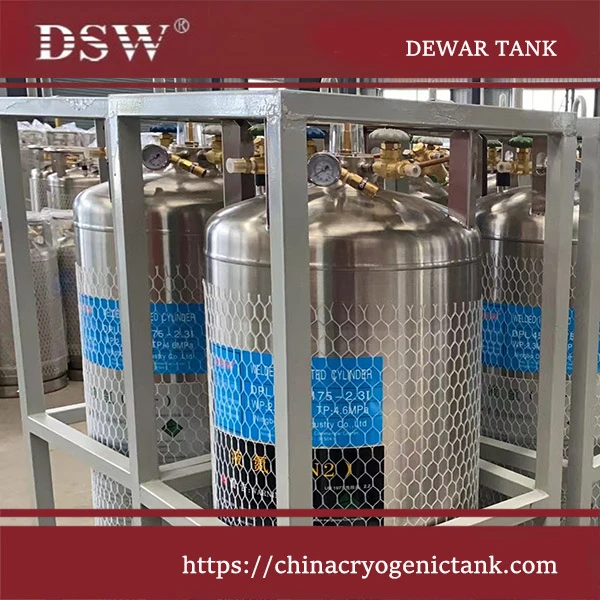
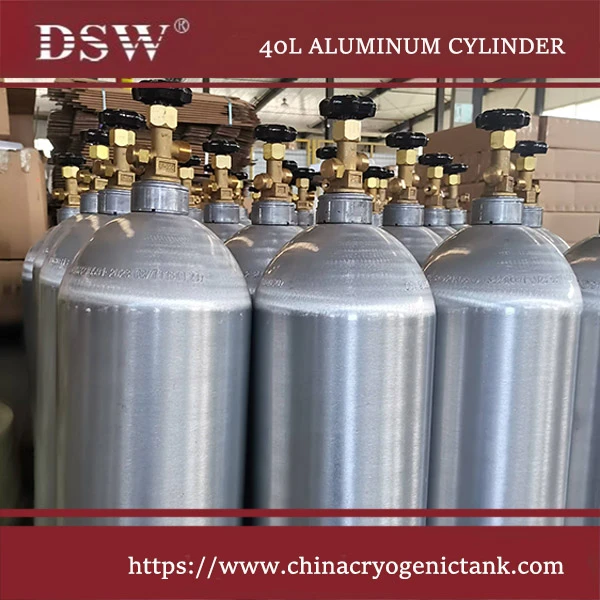
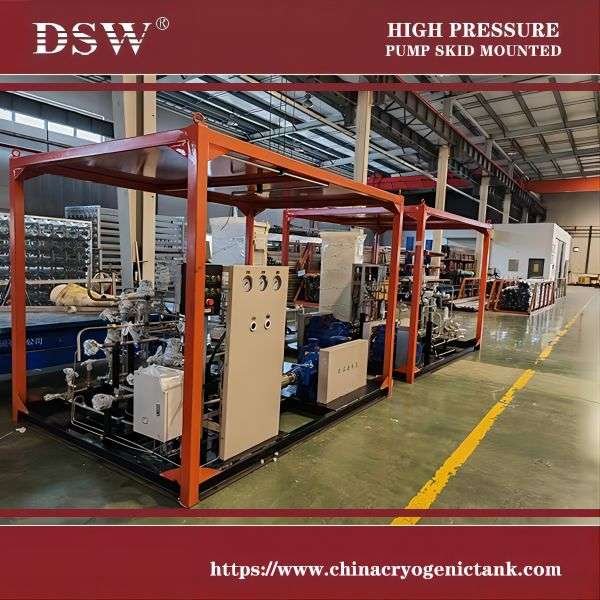
Cryogenic transport solutions are engineered systems for moving liquefied gases safely and efficiently between production facilities, filling stations, distribution centers, storage facilities, and end users.
Because cryogenic liquids are maintained at very low temperatures and may also be transported under pressure, conventional liquid tankers are not suitable for these applications. Cryogenic transport equipment requires specialized vessels, insulation systems, valves, pressure-relief devices, instrumentation, and transportation structures.
Common applications include liquid nitrogen (LIN/LN₂), liquid oxygen (LOX), liquid argon (LAr), liquid carbon dioxide (LCO₂), and LNG.
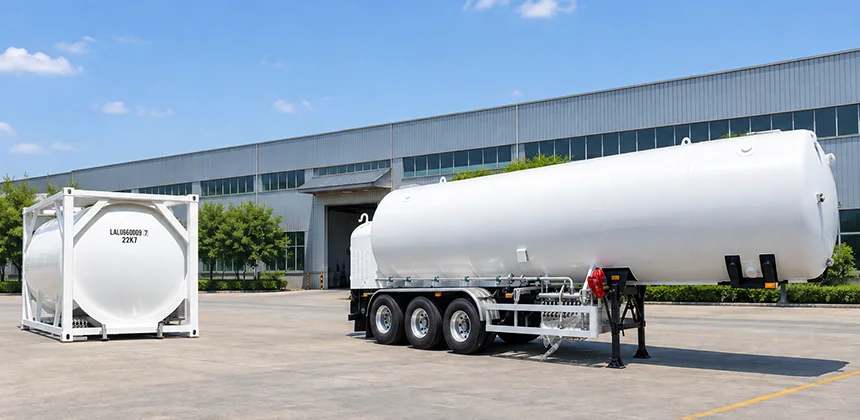
Depending on the transportation route and application, the solution may use a cryogenic tanker trailer, cryogenic semi-trailer, cryogenic ISO tank container, mobile cryogenic tank, or another specialized transport configuration.
DSW Industry provides cryogenic transport equipment for industrial gas and LNG applications, with configurations selected according to the product, capacity, pressure, transportation method, destination market, and applicable standards.
What Are Cryogenic Transport Solutions?
Cryogenic transport solutions connect the liquid-gas production or storage facility with the customer’s receiving and storage system.
A typical cryogenic supply chain can be represented as:
Production or Liquefaction → Cryogenic Storage → Loading → Cryogenic Transport → Receiving Storage → Unloading → Gas Supply
The transport vessel is therefore only one part of the overall system.
A suitable cryogenic transport solution should consider:
- Cryogenic medium
- Required liquid capacity
- Operating and design pressure
- Required holding time
- Insulation and heat-leak performance
- Transportation distance
- Road, rail, marine, or multimodal transportation
- Loading and unloading arrangements
- Receiving storage capacity
- Pump and transfer requirements
- Applicable pressure-vessel requirements
- Applicable transportation regulations
- Destination-country requirements
The best solution is not necessarily the largest tank. It is the configuration that provides the required delivery capacity while fitting the customer’s logistics, storage, operating, and regulatory requirements.
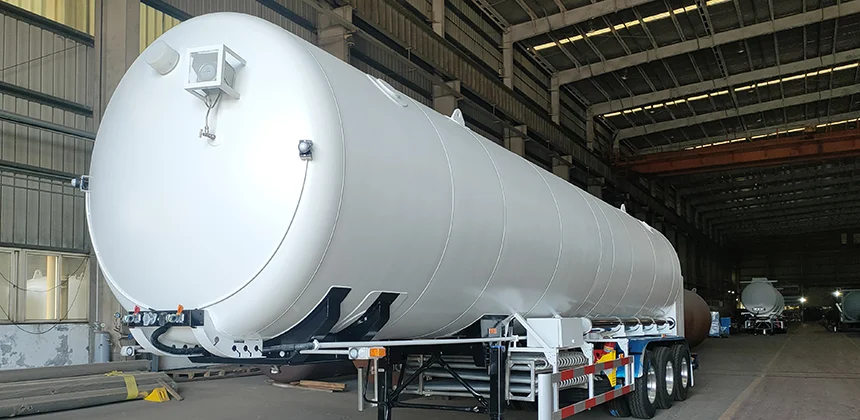
Types of Cryogenic Transport Equipment
There are several types of equipment used for cryogenic transportation. They overlap in function but are designed for different logistics requirements.
| Cryogenic Transport Type | Typical Application | Main Characteristic |
|---|---|---|
| Cryogenic Tanker Trailer | Bulk road transportation | Tank trailer configuration for liquid cargo |
| Cryogenic Semi-Trailer | Bulk road distribution | High-capacity road transportation |
| LNG Tanker Trailer | LNG road transportation | Designed specifically for LNG |
| CO₂ Tanker Trailer | Liquid CO₂ distribution | Designed for CO₂ operating conditions |
| Cryogenic ISO Tank Container | International and multimodal transport | Standardized container frame |
| Mobile Cryogenic Tank | Temporary or remote supply | Transportable storage solution |
| Specialized Transport Unit | Specific gas or project requirements | Customized engineering |
The terms cryogenic tanker trailer, cryogenic tanker, cryogenic trailer, and cryogenic semi-trailer are sometimes used interchangeably in the market. However, they should not automatically be treated as identical equipment.
The exact terminology can depend on the trailer structure, tank configuration, transportation regulations, and market.
Cryogenic Tanker Trailers
A cryogenic tanker trailer is a road-transport tank system designed to carry liquefied gases under controlled cryogenic conditions.
It normally consists of a cryogenic vessel mounted on a road trailer structure together with piping, valves, pressure-relief equipment, instrumentation, and other required components.
Cryogenic tanker trailers are used for bulk distribution where liquid gas needs to be transported from a supply facility to a receiving site.
Typical products transported include:
- Liquid nitrogen
- Liquid oxygen
- Liquid argon
- Liquid carbon dioxide
- LNG
- Other compatible liquefied gases
The vessel and equipment must be designed specifically for the intended medium. A tanker configured for one product should not automatically be assumed to be suitable for another product.
Cryogenic Semi-Trailers
A cryogenic semi-trailer is a road transport unit supported partly by its tractor through a fifth-wheel connection and supported independently when uncoupled.
The term describes the transportation configuration rather than a single tank design.
Cryogenic semi-trailers can therefore be configured for different gases, capacities, pressures, insulation systems, and operating requirements.
Typical configurations include:
- Liquid nitrogen semi-trailers
- Liquid oxygen semi-trailers
- Liquid argon semi-trailers
- Liquid CO₂ semi-trailers
- LNG semi-trailers
- Other specialized cryogenic liquid transport units
DSW’s cryogenic transport equipment range includes different capacity and pressure configurations depending on the product and design.
For detailed equipment specifications, see our Cryogenic Transport Trailers page.
Cryogenic Semi-Trailer vs. Cryogenic Tanker Trailer
These terms are closely related, but the distinction is useful when discussing cryogenic transport equipment.
A semi-trailer describes the road-trailer configuration.
A tanker trailer describes a trailer carrying a tank for liquid cargo.
Therefore, a cryogenic tanker trailer can be a type of cryogenic semi-trailer when the tank is mounted on a semi-trailer chassis.
| Term | Primary Description | Typical Configuration / Use |
|---|---|---|
| Cryogenic Tanker Trailer | A road transport unit equipped with a cryogenic tank for bulk liquid gas transportation. | Used to transport cryogenic liquids such as LN₂, LOX, LAr, LCO₂, or LNG by road. |
| Cryogenic Semi-Trailer | A semi-trailer configuration designed to carry a cryogenic transport tank. | Connected to a tractor unit through a fifth-wheel coupling and commonly used for bulk road transportation. |
| Cryogenic ISO Tank Container | A standardized tank container designed for the transportation of cryogenic liquids. | Mounted within an ISO container frame and suitable for approved multimodal transportation, including road, rail, and marine transport. |
For B2B purchasing and engineering discussions, it is better to specify the complete configuration rather than rely on terminology alone.
For example, 30 m³ vacuum-insulated liquid nitrogen semi-trailer is more precise than simply saying cryogenic tanker trailer.
Main Types of Cryogenic Semi-Trailers
Cryogenic semi-trailers can be classified in several ways, including by transported medium, insulation system, pressure, capacity, and transportation configuration.
Liquid Nitrogen Semi-Trailers
Liquid nitrogen semi-trailers transport LIN/LN₂ from production or distribution facilities to industrial customers.
Typical applications include:
- Metal fabrication
- Electronics
- Food processing
- Laboratories
- Chemical processing
- Healthcare
- Industrial manufacturing
Liquid Oxygen Semi-Trailers
LOX semi-trailers are used for bulk oxygen distribution.
Oxygen service requires appropriate material selection, cleanliness, component compatibility, and safety controls.
Liquid Argon Semi-Trailers
Liquid argon semi-trailers are used for industrial gas distribution, especially for welding, metallurgy, manufacturing, and other applications requiring bulk argon.
Liquid CO₂ Tanker Trailers
CO₂ tanker trailers transport liquid carbon dioxide for applications such as food and beverage production, welding, water treatment, and industrial processing.
CO₂ transport equipment must be designed around the pressure and temperature characteristics of carbon dioxide.
LNG Semi-Trailers
LNG semi-trailers transport liquefied natural gas between LNG facilities, satellite stations, industrial users, and other receiving locations.
Because LNG is a flammable cryogenic liquid, the equipment and operating procedures require appropriate engineering and safety measures.
Cryogenic Transport Equipment by Insulation System
Cryogenic transport vessels can also be classified according to their insulation arrangement.
Vacuum-Insulated Cryogenic Trailers
Vacuum insulation is widely used where minimizing heat transfer is important.
The annular space between the inner and outer vessels is evacuated, reducing heat transfer through gas conduction and convection. Multilayer insulation may also be incorporated into the vacuum space.
Benefits can include:
- Lower heat ingress
- Longer holding time
- Reduced product loss
- Better pressure stability
- Improved transport efficiency
Other Insulated Transport Tanks
Some low-temperature liquid transport applications use insulation arrangements other than a high-vacuum system.
The correct insulation configuration depends on the product, operating temperature, pressure, required holding time, and transportation conditions.
Therefore, cryogenic transport should not automatically be associated with one insulation technology without considering the specific equipment design.
Cryogenic ISO Tank Containers
Cryogenic ISO tank containers provide a different transportation model from dedicated road tanker trailers.
Their standardized container frame makes them suitable for international and multimodal logistics where road, rail, and marine transportation may form part of the same supply chain.
Typical applications include:
- International cryogenic liquid transportation
- Long-distance distribution
- Multimodal logistics
- Remote industrial sites
- Temporary supply
- Small-scale LNG logistics
A cryogenic ISO tank normally includes:
- Inner cryogenic vessel
- Outer vessel or protective structure
- Insulation system
- Container frame
- Filling connections
- Liquid and gas connections
- Valves
- Pressure-relief devices
- Instrumentation
For international logistics, the tank should be selected according to the specific product, route, transport modes, and applicable regulations.
See our Cryogenic ISO Tank Containers page for detailed product information.
Cryogenic Semi-Trailer vs. ISO Tank Container
| Feature | Cryogenic Semi-Trailer | Cryogenic ISO Tank |
|---|---|---|
| Primary Use | Bulk road distribution | Multimodal transportation |
| Chassis | Semi-trailer chassis | ISO container frame |
| Road Transport | Excellent | Excellent with suitable chassis |
| Rail Transport | Limited compared with ISO format | Suitable where permitted |
| Marine Logistics | Not the primary purpose | Designed for suitable intermodal logistics |
| Typical Use | Regional bulk delivery | International and multimodal supply |
| Main Selection Factor | Road delivery requirements | Complete multimodal logistics chain |
Neither system is universally better.
A customer delivering large volumes over established regional road routes may prefer a cryogenic semi-trailer, while a customer moving cryogenic liquids through international multimodal logistics may prefer an ISO tank container.
Looking for Cryogenic Transport Solutions for LNG & Industrial Gases
Consider gas, capacity, pressure, insulation, route, storage, and regulations when selecting cryogenic transport equipment.
DSW Industry can help select the right cryogenic tanker trailer, semi-trailer, LNG trailer, or ISO tank for your application.
Key Components of Cryogenic Transport Equipment
A cryogenic tanker trailer or semi-trailer is a complete engineered system rather than simply a tank mounted on wheels.
Inner Vessel
The inner vessel contains the cryogenic liquid.
Austenitic stainless steel is commonly used for many cryogenic applications because of its suitability for low-temperature service.
The material and construction must be appropriate for the intended product, temperature, pressure, and applicable design requirements.
Outer Vessel
The outer vessel or protective structure surrounds the inner vessel and forms part of the insulation and structural system.
Insulation System
The insulation system reduces heat transfer from the environment into the cryogenic liquid.
Depending on the design, this may include vacuum insulation and multilayer insulation or another suitable insulation arrangement.
Valves and Piping
Cryogenic valves and piping control:
- Filling
- Liquid discharge
- Gas withdrawal
- Pressure control
- Venting
- Isolation
- Transfer operations
Components must be selected for the cryogenic medium and operating conditions.
Pressure-Relief Devices
Pressure-relief equipment protects the vessel from unacceptable pressure conditions.
The relief system must be designed according to the vessel, product, pressure range, and applicable requirements.
Instrumentation
Depending on the configuration, instrumentation may include:
- Pressure gauges
- Level indicators
- Temperature measurement
- Pressure transmitters
- Safety monitoring devices
- Other operating indicators
Trailer Chassis and Landing Gear
Road-based semi-trailers require an appropriate chassis structure, suspension, braking system, lighting, landing gear, and other vehicle equipment.
The tank and chassis must be engineered as a suitable transportation unit.
How Cryogenic Transport Works
A typical cryogenic delivery process consists of several stages.
1. Loading
Cryogenic liquid is transferred from a production facility, storage tank, or loading station into the transport vessel.
2. Securing and Inspection
The vessel, valves, connections, pressure condition, and transportation equipment are checked before departure according to the applicable operating procedure.
3. Transportation
During transportation, the insulation system limits heat transfer. Pressure, liquid level, and other parameters may be monitored according to the equipment design and operating procedure.
4. Arrival
The receiving facility prepares the unloading connection and confirms that the receiving storage system has sufficient capacity.
5. Unloading
The cryogenic liquid is transferred from the transport vessel into the receiving storage tank. Depending on the system, unloading may use pressure differential, a pump, or another approved transfer method.
6. Return
After unloading, the transport unit is prepared for its next delivery cycle in accordance with the applicable operating procedure.
How to Choose a Cryogenic Transport Solution
Choosing the correct cryogenic transport equipment requires more than selecting tank volume.
1. Identify the Cryogenic Product
Start with the exact cryogenic medium:
- LN₂
- LOX
- LAr
- LCO₂
- LNG
- Other compatible products
The product determines important requirements for materials, temperature, pressure, safety, and equipment compatibility.
2. Determine Required Capacity
Capacity should be based on:
- Customer consumption
- Delivery frequency
- Transport distance
- Loading capacity
- Receiving storage capacity
- Required reserve
- Route efficiency
A larger tank is not automatically more economical if the customer’s receiving storage or delivery frequency cannot support it.
3. Determine Working and Design Pressure
The operating and design pressure must be established before selecting the vessel.
The required pressure depends on the cryogenic medium, delivery system, unloading method, storage arrangement, and applicable regulations.
4. Evaluate the Transportation Route
Consider whether the transport operation is:
- Domestic
- International
- Road only
- Road and rail
- Road and marine
- Fully multimodal
This is particularly important when choosing between a semi-trailer and an ISO tank.
5. Evaluate Loading and Unloading
The transport vessel must be compatible with the loading facility and receiving installation.
Consider:
- Filling connections
- Liquid discharge connections
- Gas return
- Pump requirements
- Pressure-building system
- Transfer hose requirements
- Receiving tank configuration
6. Confirm Applicable Regulations
The required standards and certifications depend on the product, tank type, design pressure, capacity, country, transportation mode, route, and applicable dangerous-goods requirements.
A certification suitable for one market should not automatically be assumed to satisfy another market.
Cryogenic Transport and Industrial Gas Supply
Cryogenic transportation is a critical part of an industrial gas supply system.
For a bulk customer, the complete system may look like:
Gas Production → Liquefaction → Storage → Cryogenic Transport → Receiving Storage → Vaporizer → Gas Distribution → Point of Use
The transport system therefore needs to be coordinated with the receiving storage tank and gas supply equipment.
For example, a customer with high continuous nitrogen consumption may require:
LN₂ Production or Supply → Cryogenic Tanker Trailer → Bulk Storage Tank → Vaporizer → Nitrogen Pipeline
The transport capacity, storage capacity, and consumption rate should be evaluated together.
For more information about the complete gas supply system, see our Industrial Gas Supply Systems guide.
Cryogenic Transport for Remote and Temporary Applications
Cryogenic transport equipment can also support sites without permanent pipeline connections or permanent bulk infrastructure.
Applications can include:
- Remote industrial facilities
- Temporary production sites
- Emergency supply
- Maintenance shutdowns
- Temporary capacity expansion
- Remote energy projects
- Construction projects
- Satellite LNG facilities
A mobile cryogenic tank or ISO tank can sometimes provide temporary storage as well as transportation.
However, whether a transport vessel can be used as temporary storage depends on its approved design, certification, operating conditions, and site requirements.
Cryogenic Transport Safety
Cryogenic transportation requires specialized procedures because of the hazards associated with extremely low temperatures, pressure, and the properties of individual gases.
Depending on the product, hazards may include:
- Extreme cold
- Pressure
- Oxygen enrichment
- Flammability
- Asphyxiation
- Material embrittlement
- Rapid vaporization
Important considerations include:
- Correct vessel design
- Suitable materials
- Proper pressure-relief protection
- Correct valve selection
- Appropriate transfer connections
- Equipment inspection
- Safe loading and unloading
- Personnel training
- Emergency procedures
- Product-specific operating procedures
- Compliance with applicable transportation regulations
LNG and oxygen require particular attention to their specific hazards.
This information is intended as general engineering guidance. Actual transport equipment and operating procedures must be based on the approved equipment design, applicable regulations, and qualified engineering assessment.
Cryogenic Transport Standards and Compliance
Cryogenic transport equipment may be subject to pressure-vessel, road-transport, dangerous-goods, and intermodal transportation requirements.
The applicable requirements vary according to the equipment and destination.
Potential standards and regulatory frameworks can include:
- ASME pressure-vessel requirements
- DOT requirements for applicable U.S. transportation equipment
- CGA requirements
- ADR requirements for applicable European road transportation
- GB standards for equipment manufactured or operated under Chinese requirements
- ISO requirements for applicable tank containers
- Other national or regional regulations
The correct certification package should therefore be determined for the specific product, tank, route, transportation mode, and destination market.
DSW provides cryogenic transport equipment in configurations designed for applicable pressure-vessel and transportation requirements according to the intended product and market.
Cryogenic Transport Applications
| Industry | Typical Application |
|---|---|
| Industrial Gas | Bulk nitrogen, oxygen and argon distribution |
| Healthcare | Bulk medical oxygen supply |
| Metal Fabrication | Oxygen and argon supply |
| Food & Beverage | CO₂ and nitrogen supply |
| Electronics | High-purity nitrogen supply |
| Chemical Processing | Industrial and specialty gas distribution |
| Energy | LNG transportation |
| Laboratories | Cryogenic liquid delivery |
| Manufacturing | Bulk industrial gas supply |
| Remote Facilities | Mobile or temporary gas supply |
The appropriate transport configuration depends on the gas, volume, route, receiving system, and applicable requirements.
DSW Cryogenic Transport Equipment
DSW manufactures and supplies cryogenic transportation equipment for industrial gas and LNG applications.
The equipment range includes:
- Cryogenic tanker trailers
- Cryogenic semi-trailers
- Liquid nitrogen transport trailers
- Liquid oxygen transport trailers
- Liquid argon transport trailers
- Liquid CO₂ transport equipment
- LNG transport equipment
- Cryogenic ISO tank containers
- Mobile cryogenic tanks
- Related cryogenic storage and transfer equipment
For detailed product information, see:
How to Choose Between a Cryogenic Tanker Trailer, Semi-Trailer and ISO Tank
| Requirement | Recommended Starting Point |
|---|---|
| High-volume regional road delivery | Cryogenic semi-trailer |
| Bulk liquid road transportation | Cryogenic tanker trailer |
| International multimodal transportation | Cryogenic ISO tank |
| LNG road distribution | LNG tanker or semi-trailer |
| Temporary remote supply | Mobile cryogenic tank or suitable ISO tank |
| Dedicated industrial gas distribution | Cryogenic tanker or semi-trailer |
| Road + rail + marine logistics | Cryogenic ISO tank |
This table provides a starting point rather than a final equipment specification. Final selection should be based on the actual gas, capacity, pressure, route, receiving facility, applicable regulations, and operating conditions.
TECHNICAL FAQs
FAQ About Cryogenic Transport
A cryogenic tanker trailer is a road transportation unit equipped with a specialized tank for transporting liquefied gases under cryogenic or controlled low-temperature conditions. It may be configured as a semi-trailer depending on its chassis and transportation arrangement.
The terms overlap. “Semi-trailer” describes the road-trailer configuration, while “tanker trailer” describes a trailer carrying a liquid tank. A cryogenic tanker can therefore be built as a cryogenic semi-trailer.
Cryogenic semi-trailers can be classified by the transported medium, such as LN₂, LOX, LAr, LCO₂, or LNG; by insulation system; by pressure and capacity; and by transportation configuration.
Depending on their design and certification, cryogenic transport tanks can be used for liquid nitrogen, liquid oxygen, liquid argon, liquid carbon dioxide, LNG, and other compatible liquefied gases.
A cryogenic semi-trailer is primarily optimized for road-based bulk transportation. A cryogenic ISO tank uses a standardized container frame and is intended for suitable multimodal transportation, including combinations of road, rail, and marine logistics.
Many cryogenic transport vessels use vacuum insulation, often combined with multilayer insulation, to reduce heat transfer. However, the insulation system depends on the product and equipment design.
The required capacity depends on product consumption, delivery frequency, route distance, receiving storage capacity, loading facilities, and transportation regulations. Capacity should be determined as part of the complete supply-chain design rather than from consumption alone.
Some transportable cryogenic tanks can support temporary or decentralized storage when their design, certification, operating conditions, and site arrangements permit it. The approved use of the specific vessel must be confirmed before deployment.
The applicable standards depend on the product, vessel design, country, transportation mode, pressure, and route. Requirements may include ASME, DOT, CGA, ADR, GB, ISO, or other national and regional requirements.