
This Cryogenic Tank Guide provides a comprehensive overview of cryogenic storage and transport tanks used for industrial gases and liquefied products. It explains how cryogenic tanks work, the major tank types, key components, manufacturing processes, sizing considerations, safety requirements, and selection criteria to help engineers, plant managers, and procurement teams choose the right solution.
Cryogenic tanks are vacuum-insulated vessels designed to safely store or transport liquefied gases at extremely low temperatures, typically below −150°C (−238°F). Depending on the application, cryogenic systems range from portable dewars and microbulk tanks to large stationary bulk vessels, ISO tank containers, and road transport trailers.
These systems play a critical role in industries such as healthcare, industrial manufacturing, food processing, electronics, energy, LNG infrastructure, laboratories, and scientific research by providing a reliable, efficient, and safe supply of cryogenic liquids.
Compared with high-pressure cylinder systems, cryogenic storage offers improved operational efficiency, lower gas costs, reduced handling risks, and greater supply continuity for medium- and high-volume users.
For more technical resources, visit our BluNet Engineering Knowledge Hub covering industrial gases, cryogenic equipment, storage technologies, and gas supply systems.
What Are Cryogenic Tanks?
A cryogenic tank is a double-walled, vacuum-insulated pressure vessel used to store liquefied industrial gases such as liquid oxygen (LOX), liquid nitrogen (LIN), liquid argon (LAR), liquid carbon dioxide (LCO₂), and liquefied natural gas (LNG).
These gases are stored in liquid form to significantly reduce volume. For example, one liter of liquid nitrogen expands to approximately 700 liters of nitrogen gas at ambient conditions.
This high expansion ratio makes cryogenic storage significantly more efficient than compressed gas cylinders for medium and large-scale industrial applications.
Common cryogenic liquids include:
- Liquid Oxygen (LOX)
- Liquid Nitrogen (LIN/LN₂)
- Liquid Argon (LAR)
- Liquid Carbon Dioxide (LCO₂)
- Liquefied Natural Gas (LNG)
- Liquid Hydrogen (LH₂)
- Liquid Helium (LHe)
Types of Cryogenic Tanks?
Cryogenic Dewars
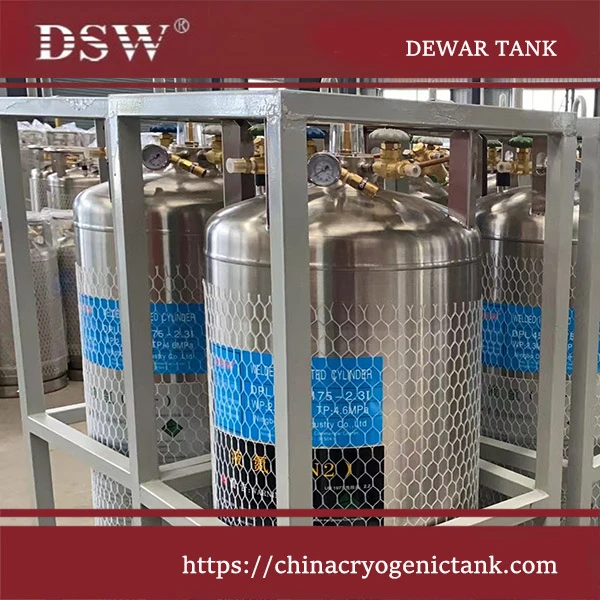
Cryogenic dewars are portable vacuum-insulated containers typically ranging from 5–500 litres. They are commonly used in laboratories, medical facilities, IVF clinics, and small industrial applications requiring intermittent liquid supply.
Microbulk Systems
Microbulk systems bridge the gap between cylinders and bulk storage, typically offering capacities from 450–5,000 litres. They are ideal for medium-volume users seeking automated supply without the footprint of large stationary installations.
Stationary Bulk Tanks
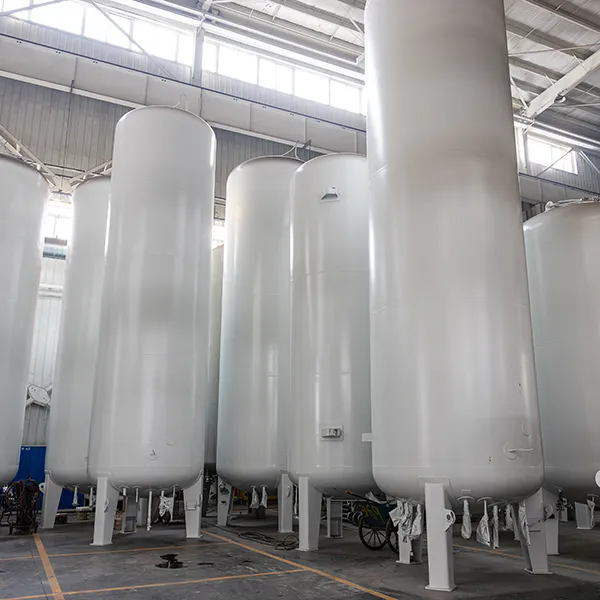
A stationary bulk cryogenic tank is a permanently installed industrial gas storage system designed for high-volume gas supply. These installations are typically located outdoors and connected to vaporizers, pressure control systems, and facility gas distribution pipelines.Designed in compliance with ASME, GB150, and ISO 21009 standards for industrial cryogenic pressure systems.A complete cryogenic bulk storage system normally includes:
Vacuum insulated cryogenic storage vessel
Ambient air vaporizer system
Pressure building circuit
Gas pressure regulation manifold
Safety relief and protection devices
Process gas pipeline distribution network
Level and pressure instrumentation
ISO Cryogenic Tanks
ISO cryogenic tanks are intermodal containers designed according to international transport regulations. They facilitate global transportation of cryogenic liquids via road, rail, and sea while maintaining product integrity and thermal efficiency.
Cryogenic Trailers
Cryogenic trailers transport large quantities of liquid gases between production plants and end users. Typical capacities range from 20–60 m³.
LNG Vehicle Fuel Tanks
Specialised LNG fuel tanks provide onboard storage for heavy-duty trucks, marine vessels, and off-grid energy systems.
Types of Cryogenic Tank Comparison
| Cryogenic Tank Type | Typical Capacity | Mobility | Best For |
|---|---|---|---|
|
Dewars Portable vacuum-insulated vessels |
5–500 L | Portable | Laboratories, IVF clinics, research facilities |
|
Microbulk Tanks Automated small bulk storage systems |
450–5,000 L | Fixed Installation | Medium-volume users, laser cutting, food processing |
|
Stationary Bulk Tanks Large on-site cryogenic storage vessels |
5–100 m³ | Fixed Installation | Factories, hospitals, semiconductor plants |
|
ISO Tank Containers Intermodal cryogenic transport tanks |
10–50 m³ | Intermodal | International transport by road, rail, and sea |
|
Cryogenic Semi-Trailers High-capacity road distribution systems |
20–60 m³ | Road Transport | Industrial gas distribution and regional deliveries |
|
LNG Fuel Tanks Vehicle-mounted LNG storage systems |
100–1,500 L | Vehicle-Mounted | LNG-powered trucks, marine vessels, off-grid energy systems |
Dewars are ideal for low-volume laboratory use, microbulk systems suit medium consumption, while stationary bulk tanks provide the lowest long-term gas cost for high-demand facilities. ISO tanks and semi-trailers support cryogenic logistics, whereas LNG fuel tanks are designed specifically for mobile energy applications.
How Cryogenic Tanks Work
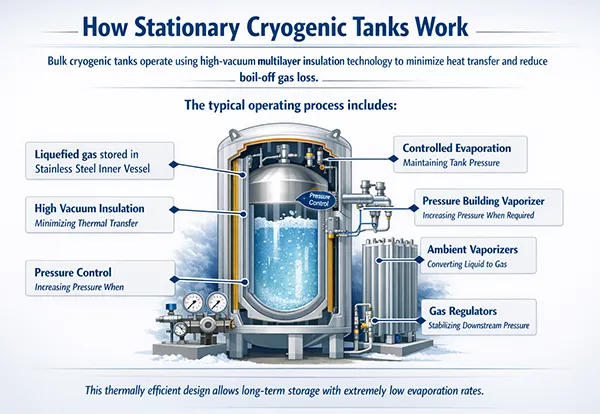
Cryogenic tanks operate using vacuum insulation technology combined with controlled pressure management systems. The goal is to minimize heat transfer and maintain stable liquid conditions inside the tank.
Working process includes:
- Liquefied gas stored inside a stainless steel inner vessel
- Vacuum insulation reduces heat ingress from the environment
- Small heat leakage causes controlled evaporation (boil-off gas)
- Pressure building system maintains stable operating pressure
- Vaporizer converts liquid into usable gas for distribution
This integrated system ensures continuous gas supply without the need for external compression equipment.
Key Components of a Cryogenic Tank System
A cryogenic tank system consists of multiple integrated components that ensure safe storage, pressure control, and gas delivery.
- Inner Pressure Vessel: Stores cryogenic liquid under controlled pressure conditions
- Outer Jacket: Provides structural support and houses the vacuum insulation system
- Vacuum Insulation System: Minimizes heat transfer and reduces boil-off losses
- Pressure Building System: Maintains stable internal pressure for gas delivery
- Safety Protection System: Prevents overpressure and ensures operational safety
- Vaporizer System: Converts liquid cryogen into usable gas
Each subsystem is engineered to work together to ensure continuous and safe industrial gas supply.
Cryogenic Tank Engineering Standards
Cryogenic tanks are designed and manufactured according to international pressure vessel and cryogenic system standards to ensure safety, durability, and performance reliability.
- ASME Boiler and Pressure Vessel Code Section VIII
- EN 13458 Cryogenic Vessel Standard
- ISO 21009 Cryogenic Vessel Requirements
- GB 150 Pressure Vessel Standards
Key Manufacturing Processes
Cryogenic storage tanks are manufactured under strict compliance with ASME, GB150, and ISO 21009 standards. The process ensures structural integrity, vacuum insulation performance, and long-term safety for industrial gas applications.
Material Selection and Traceability
Inner vessels use austenitic stainless steel (304L / 316L / S30408) for cryogenic toughness, while outer jackets are carbon steel with anti-corrosion coating.
All materials are fully traceable through MTC certification.
– Verified chemical and mechanical properties
– Cryogenic impact toughness testing
– Full batch traceability system
Inner Vessel Fabrication and Welding
Inner vessels are formed using CNC rolling and precision welding processes. TIG or submerged arc welding ensures structural strength and leak prevention.
– Shell forming and alignment
– Automatic longitudinal and circumferential welding
– Dimensional and weld quality inspection
All welds undergo non-destructive testing.
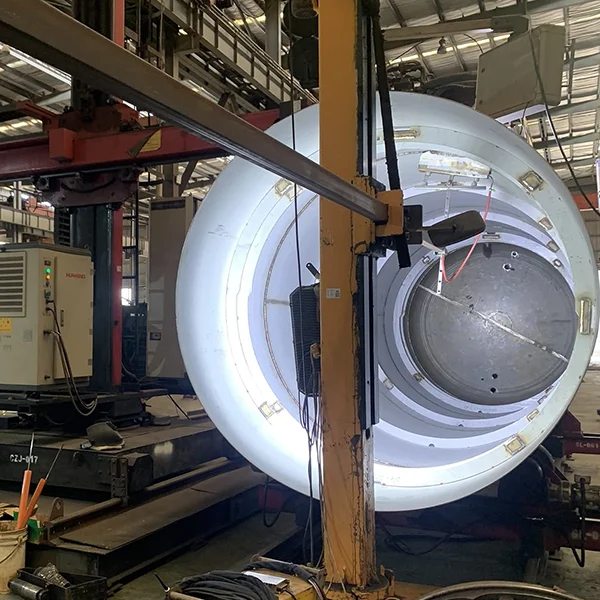
Non-Destructive Testing (NDT)
Critical welds are inspected using standard industrial methods:
– Radiographic Testing (RT)
– Ultrasonic Testing (UT)
– Dye Penetrant Testing (PT)
This ensures compliance with pressure vessel safety standards.
Vacuum Insulation Assembly
The inner vessel is installed inside the outer jacket to form a double-wall structure. The annular space is evacuated and filled with insulation material.
– High vacuum evacuation to reduce heat transfer
– Perlite or multilayer insulation (MLI)
– Precision alignment to minimize thermal bridges
Vacuum and Leak Testing
Vacuum integrity is verified before final certification.
– Helium leak detection testing
– Vacuum decay monitoring
– Seal integrity verification
Pressure and Safety Testing
Final validation ensures operational safety and compliance.
– Hydrostatic pressure test
– Gas tightness test
– Safety relief valve calibration
Manufacturing control ensures each cryogenic tank achieves long service life, stable performance, and compliance with international industrial standards.
Which Cryogenic Tank Should You Choose?
Choosing the right cryogenic tank depends mainly on how much gas you use, how often you need supply, and your application type. Below is a simple guide to help you select the right system.
1. Dewar Cylinders (Very Small Use)
Best for small-scale or laboratory use where gas demand is low and not continuous.
Use if you:
- Work in a laboratory or research center
- Need gas only occasionally
- Have very small consumption
Limitations:
- Needs frequent refilling or handling
- Higher cost per unit of gas
2. Microbulk Tanks (Small to Medium Use)
Best for users who need regular gas supply but not large industrial volumes.
Use if you:
- Run small factories or workshops
- Use gas daily but in moderate amounts
- Want fewer cylinder changes
Benefits:
- More stable gas supply
- Lower cost than cylinders
- Less manual handling
3. Stationary Bulk Tanks (Industrial Use)
Best for large and continuous gas demand in industrial production.
Use if you:
- Run large factories or production lines
- Need gas 24/7 without interruption
- Want the lowest gas cost per unit
Benefits:
- Continuous gas supply
- Very low operating cost
- Fully automated system
4. ISO Tanks (Transport Use)
Best for transporting cryogenic gas between locations or countries.
Use if you:
- Need to move gas internationally or long distance
- Operate in gas logistics or trading
5. Cryogenic Semi-Trailers (Large Transport Use)
Best for large-scale gas delivery and distribution.
Use if you:
- Deliver gas to multiple industrial sites
- Need high-volume mobile supply
Quick Selection Guide
| Gas Usage Level | Best Choice |
|---|---|
| Very small use | Dewar Cylinder |
| Small to medium use | Microbulk Tank |
| Large industrial use | Stationary Bulk Tank |
| Transport / logistics | ISO Tank or Semi-Trailer |
Simple Rule
As your gas usage increases, you move from dewars → microbulk → bulk tanks.
For continuous industrial production, bulk cryogenic tanks are usually the most efficient and cost-effective option.
Standard Pressure vs Medium Pressure Cryogenic Tanks
Cryogenic tanks are also classified by operating pressure:
- Standard pressure tanks: 8–12 bar
- Medium pressure tanks: 13–25 bar
- High pressure designs for special applications
Higher pressure tanks allow higher flow rates and improved gas delivery stability for demanding industrial processes.
| Technical Parameter | Standard Pressure System (8–12 bar) | Medium Pressure System (13–25 bar) | Engineering Notes |
|---|---|---|---|
| Design Pressure (MAWP) | Approximately 1.5× nominal operating pressure | Approximately 1.5× nominal operating pressure with higher mechanical stress | Designed according to ASME Section VIII / EN 13458 standards |
| Material & Wall Thickness | Stainless steel or aluminium, moderate thickness (~5–10 mm) | Reinforced stainless steel, increased thickness (~10–20 mm) | Wall thickness calculated using pressure stress formula (σ = PR/t) |
| Boil-Off Rate (BOR) | 0.1% – 0.3% per day (low evaporation loss) | 0.15% – 0.4% per day (slightly higher thermal loss) | Influenced by vacuum quality and multilayer insulation (MLI) |
| Pressure Control System | Simple pressure safety valve (PSV) control | Active regulation system with pressure-building and control valves | Ensures stable delivery under varying consumption demand |
| Gas Flow Capacity | Moderate flow suitable for low-to-medium demand | High flow capacity with reduced pipeline pressure loss | Higher pressure improves ΔP-driven gas delivery efficiency |
| Typical Applications | Laboratories, small workshops, light industrial use | Continuous industrial use: welding, medical gas, food freezing, manufacturing | Medium pressure preferred for stable high-demand operations |
| Safety Configuration | Standard PSV and rupture disk protection | Redundant safety valves, automated monitoring systems | Higher stored energy requires enhanced safety architecture |
| Cryogenic Temperature Behavior | LN₂ −196°C, LAr −186°C, LOX −183°C (stable operation) | Same cryogenic temperatures with added mechanical stress effects | Thermal contraction must be considered at higher pressure levels |
| Fabrication & Cost | Standard fabrication, moderate cost | Higher cost due to reinforcement and stricter welding requirements | Requires higher NDE inspection and tighter tolerances |
| Installation & Integration | Standard ISO connections and piping layout | Reinforced supports and upgraded pipeline systems | Designed for integration into high-flow industrial gas networks |
Advantages of Stationary Bulk Cryogenic Tank Systems
- Continuous and stable industrial gas supply
- Lower total gas cost compared to cylinders
- Reduced labor and handling requirements
- Improved operational safety
- Lower transportation and logistics emissions
- High scalability for industrial expansion
Industries Using Stationary Cryogenic Tanks
Manufacturing and Metal Fabrication
- Laser cutting nitrogen supply
- Welding shielding gases
- Heat treatment atmosphere control
- Metal processing
Healthcare and Medical Gas Systems
- Hospital oxygen supply systems
- Medical gas pipeline systems
- Laboratory research applications
Food and Beverage Processing
- Cryogenic freezing tunnels
- Food preservation
- Modified atmosphere packaging
- Beverage carbonation
Electronics and Semiconductor Industry
- Semiconductor fabrication
- Inert gas protection
- Cleanroom processes
- Precision manufacturing
Energy and LNG Applications
- LNG peak shaving systems
- Backup fuel supply
- Power plant gas systems
Looking for a Reliable Cryogenic Storage Solution?
Whether you need bulk storage, microbulk, or on-site supply,
Cryogenic Tank Sizing Principles
Proper tank sizing is essential to ensure stable gas supply, operational efficiency, and cost optimization. Industrial systems are typically designed based on consumption demand and delivery logistics.
Key sizing factors include:
- Average daily gas consumption
- Peak demand requirements
- Delivery frequency from supplier
- Safety reserve capacity (typically 3–10 days)
- Future production expansion needs
Correct sizing helps minimize supply interruptions and reduces total gas supply costs.
Installation Requirements
Cryogenic tank installation must follow strict engineering and safety guidelines to ensure long-term operational reliability.
- Reinforced concrete foundation with load-bearing design
- Proper safety distance from buildings and equipment
- Adequate ventilation and vapor dispersion space
- Seismic and wind load considerations
- Correct piping stress support and alignment
- Vaporizer installation with airflow clearance
Maintenance and Safety Inspection<
Cryogenic tanks require low but regular maintenance to ensure long-term safety and performance stability.
Routine inspection includes:
- Daily pressure and level monitoring
- Leak detection and valve inspection
- Safety relief valve functionality checks
- Instrumentation calibration
- Vacuum system performance monitoring
Proper maintenance allows cryogenic systems to achieve a service life of 20 years or more.
Bulk Storage Tanks vs Microbulk vs Cryogenic Dewars
| System Type | Capacity Range | Best Application | Key Advantages |
|---|---|---|---|
| Bulk Cryogenic Tanks | 5 – 100+ m³ | High-consumption industrial production | Continuous gas supply, lowest cost per Nm³, high efficiency |
| Microbulk Systems | 1 – 5 m³ | Medium consumption users (factories, workshops) | Flexible supply, reduced cylinder handling, moderate investment |
| Dewars | 50 – 500 L | Laboratories, research, small-scale use | Portable, simple operation, suitable for intermittent supply |
TECHNICAL FAQs
About Stationary Bulk Cryogenic Storage
Modern stationary tanks typically have static evaporation rates between 0.2% and 0.6% per day depending on tank size and insulation quality.
Typical operating pressures range from 8 bar to 25 bar depending on system design.
Annual inspection is typical, with daily operator checks recommended.
Common standards include ASME, PED, ISO 21009, and GB pressure vessel codes.
Related Cryogenic Tank Resources
More Technical Information about Stationary Bulk Cryogenic Storage
Conclusion
Cryogenic tank systems are essential infrastructure for modern industrial gas supply chains. Their combination of vacuum insulation technology, pressure control systems, and engineered safety design ensures reliable performance across a wide range of industries.
Understanding tank types, components, engineering standards, and operational requirements allows engineers and procurement teams to select the most efficient and cost-effective cryogenic storage solution for their applications.