
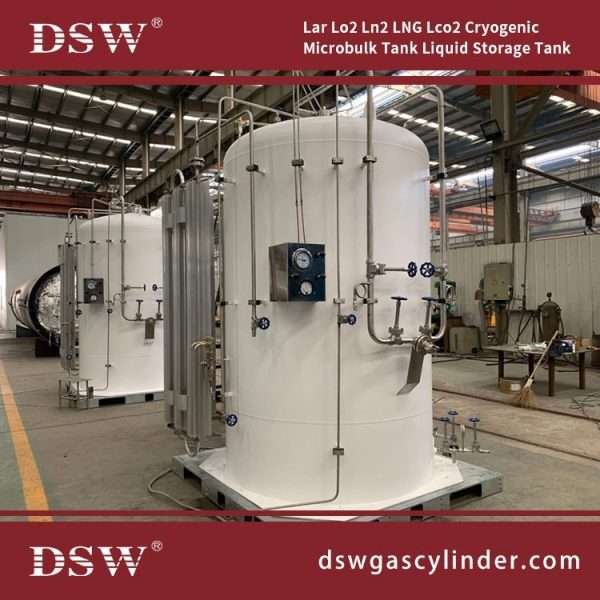
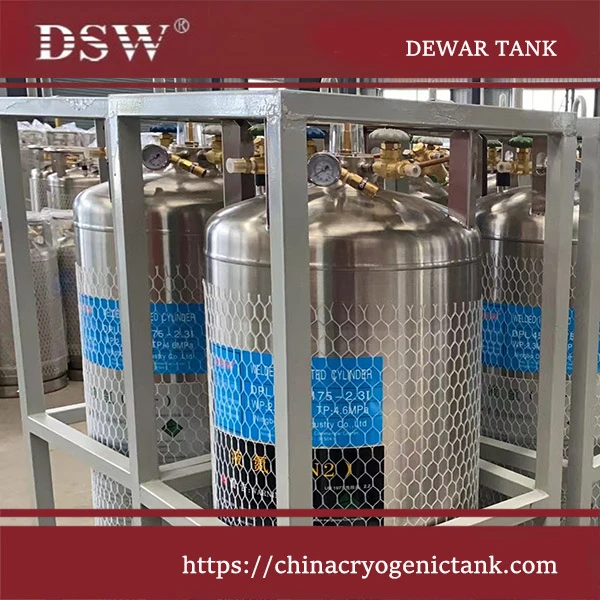
There are several types of LNG storage tanks used across the natural gas industry, from vacuum-insulated cryogenic tanks for industrial and fueling applications to large full-containment tanks used at LNG terminals.
However, LNG tanks cannot be classified by one characteristic alone. Tank geometry, insulation technology, containment design, installation method, and transportation function are different engineering considerations. For example, a tank can be vertical and vacuum insulated, while a large terminal tank may be above-ground and full containment.
The appropriate LNG storage tank depends on factors such as storage capacity, operating pressure, LNG application, site conditions, thermal insulation requirements, filling and withdrawal rates, safety requirements, and applicable codes and standards.
This guide explains the major types of LNG storage tanks, how they differ, where they are used, and what factors should be considered when selecting an LNG storage system.
How Are LNG Storage Tanks Classified?
LNG storage tanks can be classified according to several different characteristics. Using these categories together gives a more accurate picture of LNG storage technology.
| Classification | Examples | What It Describes |
|---|---|---|
| Geometry | Vertical, horizontal | Physical shape and orientation |
| Insulation | Vacuum insulated, non-vacuum cryogenic insulation | How heat transfer is reduced |
| Containment | Single, double, full containment | How LNG is contained in normal and abnormal conditions |
| Installation | Above-ground, below-grade, or underground | Where the storage system is installed |
| Application | Industrial, fueling, terminal, peak-shaving | The purpose of the LNG storage system |
| Transportation | LNG ISO tank containers | Transportable cryogenic LNG storage |
This distinction is important because terms such as vertical, vacuum insulated, and full containment should not be treated as mutually exclusive tank types. They describe different aspects of tank design.
Main Types of LNG Storage Tanks
For practical discussion, LNG storage systems can be grouped into the following major categories:
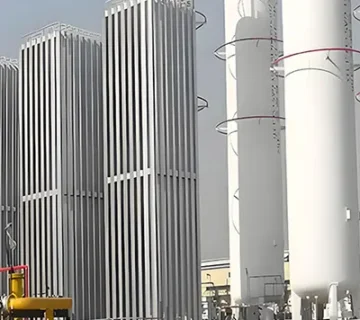
- Vertical vacuum-insulated LNG storage tanks
- Horizontal LNG storage tanks
- Large above-ground LNG containment tanks
- Single-containment LNG tanks
- Double-containment LNG tanks
- Full-containment LNG tanks
- Underground or below-grade LNG storage systems
- LNG ISO tank containers
Some of these categories overlap. For example, a large LNG tank can be vertical, above-ground, and full-containment at the same time. A smaller LNG tank can be vertical, double-wall, vacuum insulated, and designed for pressurized storage.
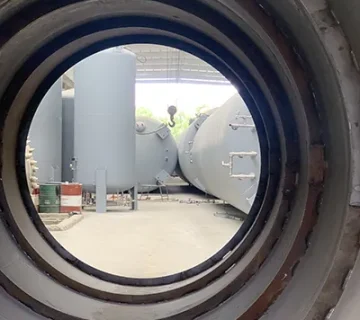
2. Horizontal LNG Storage Tanks
Horizontal LNG storage tanks use a cylindrical tank positioned horizontally. They can be designed as double-wall cryogenic vessels and may use vacuum insulation depending on the application and tank design.
Horizontal construction can be useful where site conditions, installation height, transportation, access, or system layout favor a lower-profile tank.
Potential Advantages
- Lower overall equipment height
- Can suit sites with vertical-space limitations
- Suitable for certain modular LNG systems
- Can simplify some transportation and installation arrangements
- Can be integrated with packaged LNG equipment
The choice between a horizontal and vertical LNG tank should be based on the complete installation rather than orientation alone. Capacity, foundation requirements, available land, piping, maintenance access, transportation limitations, and future expansion should all be considered.
3. Large Above-Ground LNG Storage Tanks
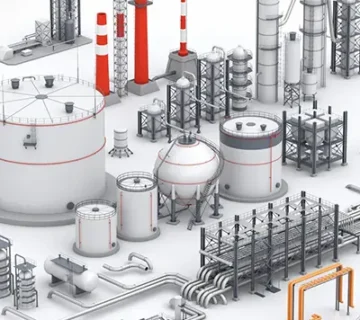
Large above-ground LNG storage tanks are used at major LNG terminals and other facilities that require substantial LNG inventories.
These tanks are fundamentally different from smaller vacuum-jacketed LNG pressure vessels. Large LNG tanks typically use a primary LNG-containing tank together with engineered insulation and a secondary containment structure or system.
DOE project documentation for large LNG facilities describes full-containment tanks incorporating a low-temperature inner tank, reinforced concrete outer tank, insulation systems, foundation heating, pumps, instrumentation, and pressure/vacuum protection.
Large LNG storage tanks are commonly used for:
- LNG import terminals
- LNG export facilities
- Large LNG receiving facilities
- Regasification terminals
- Large-scale LNG storage facilities
- Peak-shaving facilities
At an LNG receiving terminal, LNG can be unloaded from carriers into well-insulated storage tanks before being regasified or transferred for further distribution.
4. Single-Containment LNG Tanks
Single-containment LNG tanks use a primary LNG-containing tank together with a separate secondary containment arrangement, such as an external bund or impoundment system, depending on the project design.
The primary tank is responsible for containing the LNG under normal operating conditions. The surrounding secondary containment is designed to manage a release from the primary container according to the applicable facility requirements.
Single-containment systems are one of the established onshore LNG storage concepts identified in industry guidance. GIIGNL materials distinguish single-, double-, and full-containment systems as major onshore LNG storage designs.
5. Double-Containment LNG Tanks
Double-containment LNG tanks use a primary inner tank and a separate outer containment structure.
The inner tank normally provides primary LNG containment, while the outer structure provides additional containment capability and can also form part of the insulation and structural system.
Depending on the design, the outer structure may be constructed from reinforced concrete or another suitable material. The exact configuration depends on tank size, project requirements, design standards, and site conditions.
Double-containment designs are generally associated with larger LNG storage systems rather than the small vacuum-insulated tanks commonly found at fueling stations.
6. Full-Containment LNG Tanks
Full-containment LNG tanks are designed with a primary inner tank and an outer containment structure that provides an additional level of containment for LNG and vapor under specified failure scenarios.
Large full-containment LNG tanks can incorporate:
- Low-temperature steel inner tank
- Reinforced concrete outer tank
- Thermal insulation
- Suspended insulation deck
- Foundation and frost-protection systems
- Submerged LNG pumps
- Internal piping
- Pressure and vacuum protection
- Level, pressure and temperature instrumentation
- Fire and gas detection systems
For example, DOE documentation for large LNG projects describes full-containment tanks using a low-temperature 9% nickel steel inner tank, reinforced concrete outer wall, insulation systems, submerged pumps, foundation heating, and pressure/vacuum relief equipment.
Full-containment design should be understood as a containment concept, not simply a tank shape. A full-containment LNG tank may still be a vertical cylindrical, above-ground tank.
7. Underground and Below-Grade LNG Storage Tanks
Underground or below-grade LNG storage can be used for certain applications where site layout, land availability, environmental conditions, or other project requirements favor a below-grade installation.
DOE’s LNG vehicle-fueling guidance notes that LNG can be stored above or below ground at fueling stations using highly insulated tanks. Below-ground installation can provide site-specific benefits, including reduced exposure to ambient conditions and different space-utilization characteristics.
However, below-grade LNG storage introduces additional engineering considerations, including:
- Soil conditions
- Groundwater
- Drainage
- Foundation design
- Inspection access
- Ventilation
- Heat transfer
- Corrosion protection
- Emergency access
- Applicable regulations
Underground installation should therefore be considered a project-specific configuration rather than automatically being considered superior to above-ground storage.
8. LNG ISO Tank Containers
LNG ISO tank containers are transportable cryogenic containers designed for LNG transportation by road, rail, sea, or multimodal logistics.
Unlike a stationary LNG storage tank, an ISO tank is designed around transportation requirements. It combines a cryogenic tank with a standardized container frame so that the unit can be moved between different transportation modes.
DOE identifies containerized LNG as part of the small-scale LNG supply chain, where cryogenic containers can be used for smaller-volume LNG transportation.
Typical applications include:
- Small-scale LNG distribution
- Satellite LNG facilities
- Remote industrial customers
- Road transportation
- Rail transportation
- Multimodal LNG logistics
- International LNG transportation
For more information, see our cryogenic ISO tanks.
Vacuum-Insulated LNG Tanks
Vacuum-insulated LNG tanks deserve separate consideration because vacuum insulation is an insulation technology rather than a complete tank classification.
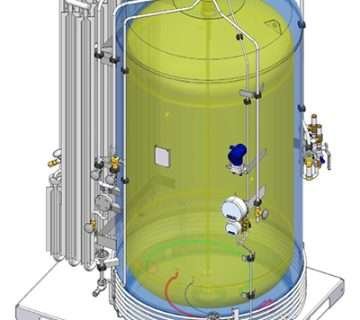
In a typical vacuum-insulated cryogenic vessel, an inner tank contains the LNG while an outer vessel surrounds the insulation space. The vacuum reduces heat transfer through the annular space, helping maintain the low temperature required for LNG storage.
Vacuum-insulated tanks are widely used in smaller and medium-scale LNG applications. DOE guidance for LNG fueling systems describes double-walled, vacuum-insulated storage vessels and identifies them as common bulk LNG fuel-storage equipment.
However, not all LNG tanks are vacuum insulated. Large terminal storage tanks generally use different large-scale insulation and containment architectures.
This distinction is important when comparing LNG tank products from different manufacturers.
Vertical vs Horizontal LNG Storage Tanks
| Feature | Vertical LNG Tank | Horizontal LNG Tank |
|---|---|---|
| Orientation | Vertical | Horizontal |
| Footprint | Generally smaller ground footprint for a given cylindrical arrangement | Generally requires more ground length |
| Height | Greater equipment height | Lower profile |
| Typical use | Bulk LNG and industrial storage | Certain compact or modular installations |
| Site consideration | Available ground area and height restrictions | Available ground length and access |
Neither configuration is universally suitable for every project. Tank orientation should be selected together with capacity, foundation, piping, transportation, maintenance, and site-layout requirements.
LNG Tank Containment Types Compared
| Containment Type | Primary LNG Containment | Secondary Containment | Typical Context |
|---|---|---|---|
| Single containment | Primary tank | Separate bund or impoundment arrangement | Large stationary LNG storage |
| Double containment | Inner tank | Outer containment tank | Large LNG storage facilities |
| Full containment | Inner tank | Outer containment structure designed for additional liquid/vapor containment | Large LNG terminals and storage facilities |
Industry guidance identifies single-, double-, and full-containment concepts as established onshore LNG storage designs. The exact requirements and terminology depend on the applicable design standard and project specification.
LNG Storage Tank Types by Application
Another practical way to classify LNG tanks is according to where and why they are used.
| Application | Typical Storage Solution | Main Requirement |
|---|---|---|
| LNG Fueling Station | Vacuum-insulated cryogenic tank | Reliable storage and rapid fuel delivery |
| Industrial Facility | Vertical or horizontal cryogenic tank | Continuous LNG fuel supply |
| Satellite LNG Facility | Bulk LNG tank or ISO tank system | Storage and distribution without pipeline access |
| LNG Import Terminal | Large containment tank | Large inventory and terminal integration |
| LNG Export Facility | Large containment tank | Buffer storage before LNG loading |
| Small-Scale LNG Logistics | LNG ISO tank or transportable cryogenic container | Multimodal transportation |
LNG Storage Tank vs LNG ISO Tank
Although both can contain LNG, a stationary LNG storage tank and an LNG ISO tank have different primary functions.
| Feature | Stationary LNG Storage Tank | LNG ISO Tank |
|---|---|---|
| Primary Purpose | Fixed LNG storage | LNG transportation and transportable storage |
| Installation | Permanent or semi-permanent site installation | Transportable |
| Transportation | Not normally transported after installation | Designed for multimodal transportation |
| Typical Applications | Plants, terminals, and fueling stations | Satellite supply and LNG logistics |
DOE describes small-scale and containerized LNG as part of the broader LNG supply chain, where specialized cryogenic containers can transport LNG in smaller quantities.
What Determines the Choice of LNG Storage Tank?
Selecting an LNG tank requires consideration of the complete storage system rather than tank geometry alone.
1. Required Storage Capacity
Tank capacity should be based on LNG consumption, delivery frequency, required reserve inventory, storage duration, peak demand, and future expansion.
2. Operating and Design Pressure
The operating pressure affects tank construction, piping, valves, pressure-control equipment, and relief systems.
3. LNG Storage Duration
Longer storage periods increase the importance of insulation performance, heat leak, pressure management, and boil-off-gas handling.
4. Site Conditions
Available land, soil conditions, groundwater, seismic requirements, ambient conditions, access, elevation, and foundation requirements can influence the appropriate tank configuration.
5. Filling and Withdrawal Rates
The tank and associated piping must accommodate LNG delivery, filling, liquid withdrawal, vapor return, and downstream demand.
6. Insulation Requirements
The insulation system must minimize heat transfer and support the required LNG storage performance. Vacuum insulation may be appropriate for some smaller cryogenic vessels, while large LNG tanks require different engineered insulation systems.
7. Applicable Codes and Regulations
The appropriate codes depend on the tank type, facility, country, and application. Large LNG projects can involve requirements associated with standards such as NFPA 59A, API 625, and applicable local regulations. Project-specific code selection should be established during engineering rather than assumed from the tank type alone. DOE documentation for large LNG projects, for example, identifies NFPA 59A, 49 CFR 193, and API 625 among applicable requirements for certain full-containment facilities.
LNG Storage Tank Insulation
Insulation is one of the most important elements of LNG storage because LNG must remain at cryogenic temperature.
Common approaches include:
- Vacuum-insulated double-wall construction
- Perlite-based insulation systems
- Foam-glass insulation
- Suspended insulation decks
- Multilayer or other specialized cryogenic insulation systems
The appropriate system depends strongly on tank size and design. A vacuum-jacketed pressure vessel and a large full-containment terminal tank do not use identical insulation architectures.
For example, DOE project documentation for large full-containment tanks describes insulation below the inner tank, within the annular space, and above a suspended insulation deck.
LNG Storage Tanks and Boil-Off Gas
Even highly insulated LNG tanks receive some heat input from the surrounding environment. This can cause a portion of the LNG to vaporize, producing boil-off gas (BOG).
BOG management is particularly important for larger LNG storage facilities.
Depending on the facility design, boil-off gas can be:
- Used as fuel
- Compressed
- Returned to the process
- Recondensed
- Transferred to another part of the LNG system
- Managed through appropriate pressure-control systems
DOE documentation for LNG facilities shows BOG being routed to compressors and fuel systems as part of LNG storage operations.
BOG behavior depends on tank size, insulation, LNG inventory, ambient conditions, pressure, LNG composition, and operating procedures. It should therefore be considered during the tank-selection and system-design stages.
LNG Storage Tank Safety
LNG storage systems must address both cryogenic hazards and flammable-gas hazards.
Important safety features can include:
- Pressure relief devices
- Vacuum protection where applicable
- Emergency shutdown systems
- Gas detection
- Fire detection and protection
- Appropriate ventilation
- Level and pressure monitoring
- Temperature monitoring
- Safe separation and facility layout
- Cryogenic protection for personnel
- Inspection and maintenance procedures
The U.S. Department of Energy’s Alternative Fuels Data Center notes that LNG storage facilities require appropriate ventilation and that LNG can create cryogenic injury hazards because of its extremely low temperature.
Safety requirements vary according to the tank, facility, jurisdiction, and application. Applicable standards and local regulations should therefore be reviewed during engineering and permitting.
LNG Storage Tanks vs LPG Storage Tanks
LNG and LPG are both liquefied gases, but their storage technologies are fundamentally different.
| Characteristic | LNG | LPG |
|---|---|---|
| Primary Component | Primarily methane | Primarily propane, butane, or related hydrocarbon mixtures |
| Storage Principle | Cryogenic storage | Generally pressurized liquid storage |
| Typical Temperature | Approximately −162°C at atmospheric pressure | Much warmer than LNG |
| Insulation | Critical to cryogenic storage | Different thermal requirements |
| Common Storage Technologies | Cryogenic tanks and large LNG containment systems | Bullet, spherical, and other LPG pressure vessels |
For this reason, LNG storage tanks and LPG storage tanks should be treated as different engineering technologies rather than interchangeable liquid-gas storage vessels.
LNG Storage Tank vs Cryogenic Storage Tank
LNG storage tanks are a subset of cryogenic storage tanks.
The term cryogenic tank can cover storage systems for several products, including:
- Liquid nitrogen (LIN)
- Liquid oxygen (LOX)
- Liquid argon (LAr)
- Liquefied natural gas (LNG)
- Other cryogenic liquids
Although these products require low-temperature storage, their boiling points, operating pressures, material requirements, densities, and safety considerations are not identical.
For a broader overview, see our Cryogenic Tanks Guide.
How to Select an LNG Storage Tank Manufacturer
For an LNG storage project, manufacturer selection should consider the complete engineering and quality requirements rather than tank capacity alone.
Important evaluation factors can include:
- Experience with LNG and cryogenic equipment
- Experience with the required tank type
- Material traceability
- Welding procedures and qualifications
- Non-destructive testing capabilities
- Insulation and vacuum performance where applicable
- Pressure and leak testing
- Quality-control procedures
- Engineering documentation
- Applicable certifications and code compliance
- Inspection and testing documentation
- After-sales technical support
For customized LNG storage projects, the manufacturer should be able to evaluate the required capacity, pressure, temperature, LNG properties, installation conditions, filling and withdrawal requirements, insulation system, and applicable standards.
Cryogenic Tanks FAQs
About LNG Storage Tank Types
The main types of LNG storage tanks can be classified by geometry, containment design, insulation method, installation configuration, and application. Common examples include vertical vacuum-insulated tanks, horizontal LNG tanks, single-containment tanks, double-containment tanks, full-containment tanks, underground LNG tanks, and LNG ISO tank containers.
A vacuum-insulated LNG storage tank is a cryogenic tank designed with an insulated inner vessel and an outer vessel. The space between the vessels is maintained under vacuum and typically incorporates multilayer insulation to reduce heat transfer and limit LNG evaporation.
Vertical and horizontal LNG tanks differ mainly in vessel orientation and installation requirements. Vertical tanks generally use less ground area for a given capacity, while horizontal tanks can be suitable where site layout, access, transportation, or installation requirements favor a lower-profile configuration.
A full-containment LNG storage tank is a large storage system designed with a primary liquid-retaining inner tank and a secondary outer containment structure capable of retaining LNG in the event of a loss of containment from the inner tank. Large full-containment tanks commonly use a steel inner tank, concrete outer wall or roof structure, insulation, and dedicated pressure-control and safety systems.
Single-containment LNG tanks generally use a primary liquid-retaining tank with a separate outer structure that is not designed to retain LNG. Double-containment tanks have a primary liquid-retaining inner tank and a secondary containment wall designed to contain spilled LNG. Full-containment tanks add a secondary containment system designed to retain LNG and manage vapor within the tank structure.
No. Vacuum insulation is common in smaller and medium-sized cryogenic LNG tanks, but large LNG terminal storage tanks generally use other insulation and containment arrangements. The appropriate insulation system depends on tank size, storage duration, operating conditions, project design, and applicable standards.
An LNG ISO tank container is a standardized cryogenic tank designed for transporting and handling LNG using intermodal transportation systems. Unlike stationary LNG storage tanks, ISO tank containers are designed to be transported by road, rail, or sea and can also be used for temporary or decentralized LNG storage.
Selecting an LNG storage tank depends on required capacity, operating pressure, storage duration, filling and withdrawal rates, site conditions, installation configuration, insulation requirements, safety systems, applicable codes, and transportation or handling requirements. The tank design should be selected according to the specific LNG application and project engineering requirements.
Conclusion
The types of LNG storage tanks vary according to tank geometry, insulation technology, containment design, installation method, storage scale, and application.
For industrial and fueling applications, vertical and horizontal vacuum-insulated cryogenic tanks are commonly used. Larger LNG facilities require more complex containment systems, including single-containment, double-containment, and full-containment tank designs. Underground or below-grade configurations can be considered for specific site conditions, while LNG ISO tanks provide a transportable solution for small-scale LNG logistics.
The most important point is that these classifications overlap. A tank can be vertical, above-ground, double-wall, and vacuum insulated, while a large terminal tank can be vertical, above-ground, full containment, and non-vacuum insulated. Therefore, LNG tank selection should consider the complete engineering requirements rather than one characteristic alone.
For the fundamentals of LNG storage, see What Is an LNG Storage Tank?. For more detailed engineering considerations, see LNG Tank Design.
You can also explore our Cryogenic Tanks Guide for a broader overview of cryogenic storage technologies.



No comment