
DSW Industry provides liquid CO₂ storage solutions for industrial facilities, food and beverage processing, manufacturing plants and other applications requiring reliable carbon dioxide storage and supply. Our solutions integrate pressure-rated liquid CO₂ storage tanks, transfer equipment, vaporizers, pressure-control components and distribution systems to support different industrial consumption requirements.
From individual bulk storage tanks to integrated CO₂ storage and gas supply systems, DSW develops equipment configurations according to storage capacity, operating pressure, consumption rate, delivery conditions and site requirements. Our solutions support applications requiring continuous carbon dioxide supply, reduced dependence on cylinder handling and efficient on-site gas storage.
As part of our broader cryogenic storage solutions, DSW provides gas-specific storage equipment and system configurations for liquid carbon dioxide and other industrial gases.
Liquid CO₂ Storage and Supply System Solutions
A liquid CO₂ storage system is designed to receive, store, transfer and deliver carbon dioxide according to the requirements of the end user. Unlike conventional compressed gas cylinders, bulk liquid CO₂ storage allows larger quantities of carbon dioxide to be stored in liquid form within a pressure-rated vessel.
Depending on the application, a complete CO₂ storage and supply system may include:
- Liquid CO₂ Storage Tanks: Pressure-rated vessels designed to store refrigerated liquid carbon dioxide under controlled temperature and pressure conditions.
- CO₂ Unloading Equipment: Filling connections, transfer piping and associated valves for receiving liquid CO₂ from delivery tankers.
- Liquid CO₂ Transfer Equipment: Suitable pumps, piping and valves for transferring liquid carbon dioxide within the installation where required.
- CO₂ Vaporizers: Equipment that converts liquid carbon dioxide into gaseous CO₂ for downstream industrial applications.
- Pressure Control Equipment: Regulators, valves and related components for maintaining the required operating and delivery pressure.
- Instrumentation and Monitoring: Pressure gauges, level indicators, temperature monitoring and optional remote monitoring systems.
- Gas Distribution Equipment: Piping, manifolds and connections for delivering CO₂ to production equipment and points of use.
The final equipment configuration depends on whether the application requires liquid CO₂ delivery, gaseous CO₂ supply or both. Storage capacity, required flow rate, operating pressure, CO₂ purity and installation conditions should be considered together during system selection.
Types of Liquid CO₂ Storage Solutions
1. Bulk Liquid CO₂ Storage Systems
Bulk liquid CO₂ storage systems are designed for industrial facilities with regular or high-volume carbon dioxide consumption. Instead of relying on multiple high-pressure gas cylinders, these systems store larger quantities of CO₂ in dedicated pressure-rated storage tanks.
A typical bulk CO₂ installation includes a storage vessel, tanker unloading connections, liquid withdrawal piping, pressure and temperature monitoring equipment and suitable downstream supply components.
When gaseous CO₂ is required, the stored liquid can be supplied through a compatible vaporization system. The system can be configured according to daily consumption, peak demand, delivery frequency and required gas supply pressure.
Bulk storage is suitable for food and beverage processing, industrial manufacturing, chemical production and other facilities requiring regular carbon dioxide supply.
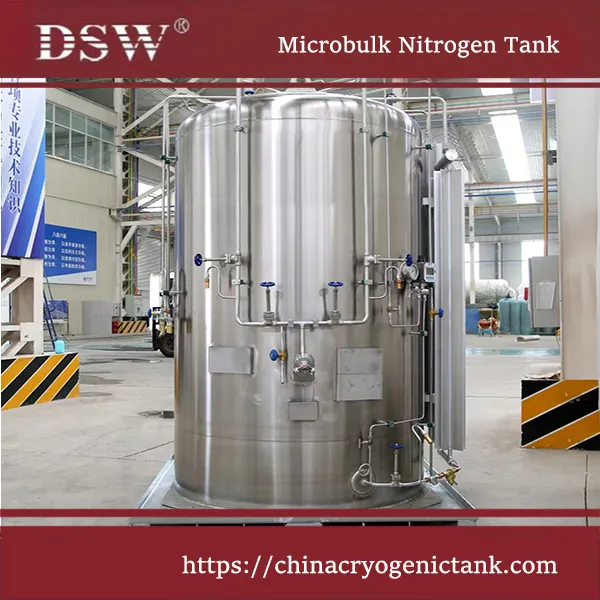
2. Liquid CO₂ Microbulk Storage Systems
Liquid CO₂ microbulk systems provide a compact storage option for facilities with small to medium consumption requirements. They offer an alternative between individual gas cylinders and larger bulk storage installations.
Microbulk configurations can integrate a compact CO₂ storage tank with filling connections, liquid withdrawal piping, pressure-control equipment and other accessories according to the application.
These systems are particularly useful where available installation space is limited or where users require a centralized carbon dioxide supply without installing a large bulk storage facility.
Typical applications include beverage production, food processing, laboratories and selected industrial manufacturing operations.
Explore our cryogenic microbulk tanks for compact liquid gas storage configurations, including suitable CO₂ storage options.
3. Liquid CO₂ Storage and Gas Supply Systems
For applications requiring gaseous carbon dioxide, liquid CO₂ storage can be integrated with a vaporizer and downstream pressure-control equipment to provide a continuous gas supply.
The liquid CO₂ is withdrawn from the storage vessel and passed through a suitable vaporizer, where heat transfer converts the liquid into gas. Pressure regulation and monitoring equipment help maintain the required delivery conditions for downstream processes.
A typical system may consist of:
- Liquid CO₂ storage tank
- Liquid withdrawal and transfer piping
- Suitable CO₂ vaporizer
- Pressure regulation and control valves
- Pressure and temperature monitoring instruments
- Gas distribution piping and connections
Vaporizer capacity should be selected according to the required gas flow rate, inlet conditions, outlet pressure, ambient temperature and operating schedule. The equipment must also be compatible with the intended CO₂ service and application.
4. Liquid CO₂ Transportation and Storage Systems
Some industrial projects require liquid CO₂ to be transported between production facilities, distribution centers and end users. In these applications, transportation equipment and stationary storage systems must be considered as part of the overall supply arrangement.
Liquid CO₂ ISO tank containers provide a transportation-oriented option for moving bulk carbon dioxide. Their pressure rating, thermal management, connection arrangement and transport approvals must be suitable for the intended cargo and transportation route.
At the receiving facility, the transported CO₂ can be transferred into a stationary storage vessel or connected to an appropriate supply arrangement, depending on the project configuration.
For transportation-related equipment, explore our cryogenic ISO tank containers, including configurations designed specifically for liquid CO₂ service.
Liquid CO₂ Storage Tank Configurations
The storage tank is the central component of a liquid CO₂ storage installation. Unlike tanks designed for atmospheric-pressure cryogenic liquids such as nitrogen and oxygen, liquid CO₂ storage vessels must accommodate the pressure-temperature relationship required to maintain carbon dioxide in its liquid state.
Tank configuration, pressure rating, insulation arrangement and material selection must be established according to the stored medium, operating conditions, storage capacity and applicable pressure vessel standards.
| Tank Configuration | Main Characteristics | Typical Applications |
|---|---|---|
| Vertical CO₂ Storage Tank | Vertical vessel arrangement with a relatively compact ground footprint. | Industrial plants, food processing and beverage production. |
| Horizontal CO₂ Storage Tank | Horizontal installation for projects with specific layout and equipment access requirements. | Industrial bulk storage and customized installations. |
| CO₂ Microbulk Tank | Compact pressure-rated storage configuration for smaller consumption requirements. | Small and medium industrial users. |
| CO₂ ISO Tank Container | Transport-oriented pressure vessel integrated with an ISO frame. | Bulk liquid CO₂ transportation and distribution. |
DSW offers liquid CO₂ storage tanks in different capacities and configurations. For more information about tank construction, pressure ratings and available specifications, see our liquid CO₂ storage tanks page.
Key Equipment in a Liquid CO₂ Storage System
Reliable CO₂ storage and supply depend on selecting compatible pressure-rated equipment and integrating the individual components into a suitable operating system.
Liquid CO₂ Storage Tanks
Liquid CO₂ storage tanks are pressure vessels designed to maintain carbon dioxide in liquid form under controlled temperature and pressure conditions. Depending on the design, the vessel may incorporate an insulated construction to reduce heat transfer and maintain stable storage conditions.
The tank design must consider maximum allowable working pressure, operating temperature, filling conditions, liquid density, pressure relief requirements and applicable pressure vessel regulations.
CO₂ Transfer and Unloading Equipment
Unloading equipment connects the delivery tanker to the stationary storage vessel. Filling connections, transfer piping, isolation valves and monitoring instruments must be selected according to the required liquid transfer rate and operating pressure.
Where liquid transfer pumps are required, their materials, pressure rating and operating characteristics must be compatible with liquid CO₂ service.
CO₂ Vaporizers
CO₂ vaporizers convert liquid carbon dioxide into gaseous CO₂ for applications requiring gas supply. The vaporizer uses heat transfer to increase the temperature of the liquid and complete the phase change.
Depending on the required capacity and operating conditions, suitable vaporization arrangements may include ambient air or water-bath heating systems. Selection should consider gas flow demand, environmental conditions, outlet temperature and pressure requirements.
Pressure Control and Safety Equipment
Pressure-control components help maintain the required storage and gas delivery conditions. The system may incorporate pressure regulators, isolation valves, pressure relief devices, gauges and other protective components.
CO₂ can present an asphyxiation hazard at elevated concentrations. Storage and supply installations therefore require appropriate ventilation, risk assessment, CO₂ detection where required, emergency procedures and suitable safety arrangements.
Instrumentation and Monitoring
Monitoring equipment provides information about tank liquid level, pressure and temperature. Depending on the installation, the system can incorporate local indicators, alarms, automatic controls and remote monitoring functions.
These instruments help operators monitor storage conditions, coordinate deliveries and identify abnormal operating conditions.
Industrial Applications of Liquid CO₂ Storage Solutions
Liquid carbon dioxide is used across a wide range of industrial processes. Bulk storage and gas supply systems help facilities manage their CO₂ consumption according to production requirements.
Food and Beverage Processing
Carbon dioxide is widely used in beverage carbonation, food packaging, modified atmosphere applications and selected food processing operations. Bulk liquid CO₂ storage provides a centralized supply source for facilities with regular consumption.
For food and beverage applications, CO₂ purity, product specifications and equipment cleanliness should be confirmed according to the intended use and applicable food safety requirements.
Industrial Manufacturing
Manufacturing facilities use CO₂ in different processes, including welding, metal fabrication, inerting and selected production operations. Liquid CO₂ storage systems can support facilities requiring a regular supply of carbon dioxide for multiple production lines.
Refrigeration and Cooling
Carbon dioxide is used in refrigeration systems and industrial cooling applications. Depending on the process, CO₂ may be supplied as a liquid or gas under controlled operating conditions.
Storage and delivery equipment must be selected according to the refrigeration system requirements, operating pressure and required CO₂ supply conditions.
Chemical and Process Industries
CO₂ is used in chemical processing, pH adjustment, water treatment and other industrial applications. Bulk storage can provide a reliable carbon dioxide supply for processes requiring controlled gas or liquid delivery.
Dry Ice Production
Liquid carbon dioxide is an important feedstock for dry ice production. Dedicated storage and transfer equipment can supply the liquid CO₂ required by dry ice manufacturing equipment.
The storage system should be configured according to the production capacity, liquid consumption rate, transfer requirements and operating schedule.
Carbon Capture and CO₂ Utilization
Captured carbon dioxide may require purification, drying, compression, liquefaction and storage before being transported or used in industrial applications. Liquid CO₂ storage tanks can form part of this downstream handling arrangement when the CO₂ quality and storage conditions are suitable.
For carbon capture projects, the storage equipment must be evaluated according to the composition of the recovered CO₂, moisture and impurity limits, operating pressure and project-specific process requirements.
How to Select the Right Liquid CO₂ Storage Solution
Selecting a suitable CO₂ storage system requires an evaluation of storage demand, pressure conditions, supply arrangements and the intended application. The storage vessel and downstream equipment should be sized as part of one coordinated system.
| Selection Factor | Important Considerations |
|---|---|
| Storage Capacity | Daily CO₂ consumption, peak demand, delivery frequency and reserve requirements. |
| Operating Pressure | Required storage pressure, maximum allowable working pressure and downstream delivery conditions. |
| Storage Temperature | Required liquid storage temperature and corresponding pressure conditions. |
| CO₂ Consumption | Liquid or gaseous demand, peak flow rate and operating schedule. |
| CO₂ Purity | Industrial, beverage, food-grade or other application-specific product requirements. |
| Equipment Configuration | Vertical or horizontal tanks, microbulk systems, unloading equipment and vaporization arrangements. |
| Installation Conditions | Available space, foundation, ventilation, access for delivery vehicles and safety requirements. |
| Applicable Standards | Pressure vessel codes, inspection requirements, certification and destination-market regulations. |
Providing these details helps determine the appropriate tank capacity, design pressure, equipment arrangement and overall CO₂ supply configuration.
Why Choose DSW for Liquid CO₂ Storage Solutions?
DSW combines pressure vessel manufacturing capabilities with industrial gas equipment integration to support different liquid CO₂ storage and supply requirements.
- CO₂ Storage Equipment: Liquid carbon dioxide storage tanks in different capacities and configurations for industrial applications.
- Flexible Storage Arrangements: Vertical, horizontal and compact storage configurations according to project requirements.
- Microbulk Storage Options: Compact CO₂ storage solutions for small and medium consumption requirements.
- Equipment Integration: Coordination of storage vessels, transfer equipment, vaporizers, valves and instrumentation.
- Project-Based Customization: Equipment configurations developed according to storage capacity, working pressure, application and installation conditions.
- International Manufacturing Support: Manufacturing and technical documentation support for customers and overseas industrial projects.
Our objective is to provide practical CO₂ storage equipment and system configurations that support reliable operation, efficient liquid handling and consistent industrial carbon dioxide supply.
Related Products and Equipment
Explore DSW’s storage equipment for liquid CO₂ and other industrial gas applications.
Pressure-rated storage vessels for bulk liquid carbon dioxide applications.
Compact storage configurations for selected liquid gas applications, including CO₂.
Transportation-oriented tank containers with configurations for liquid CO₂ service.
Request a Liquid CO₂ Storage Solution
Looking for a liquid CO₂ storage tank, microbulk system or integrated carbon dioxide supply installation? DSW can help evaluate your requirements and recommend a suitable equipment configuration.
To help us understand your project, please provide the following information:
- Required liquid CO₂ storage capacity (m³ or tons)
- Daily and peak CO₂ consumption
- Required working pressure
- Liquid or gaseous CO₂ delivery requirements
- CO₂ purity and intended application
- Preferred tank configuration
- Installation location and destination country
- Required design code and certification
Contact DSW to discuss your liquid CO₂ storage project and receive an equipment proposal based on your technical and operational requirements.